

In This Guide
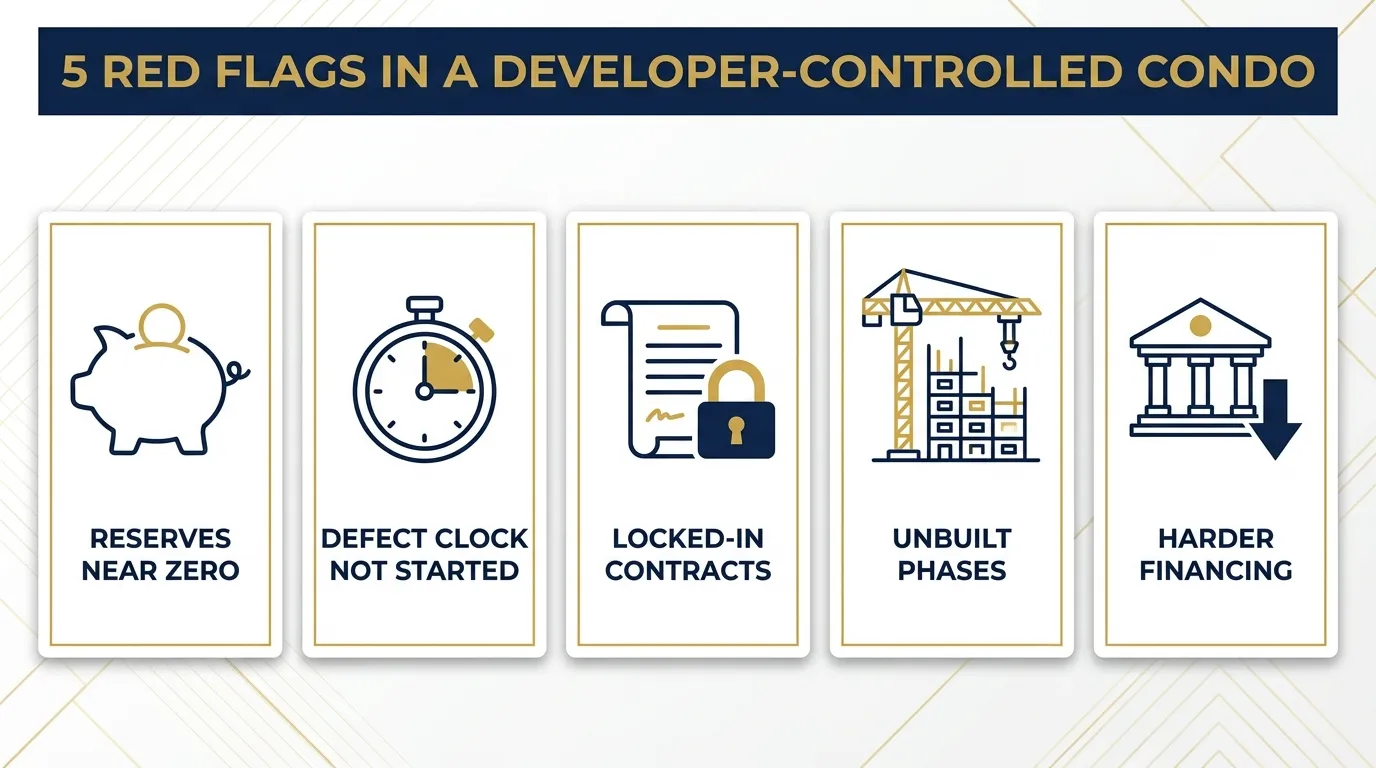
When you buy in a brand-new condo, the developer still runs the HOA. During this "developer control" or "declarant control" period, the same company that built the building also sets its budget, funds its reserves, signs its contracts, and decides whether to sue itself over construction defects. That conflict creates five red flags buyers routinely miss: reserves funded close to zero to keep dues attractive, a construction-defect clock the board has no incentive to start, long vendor contracts locked in before owners have a say, later phases that may never be built, and financing that is harder because the project isn't warrantable yet. The fix is the same in every case: read the budget, the reserve study, the turnover study, and the developer's contracts before your contingency period ends.
The model unit is flawless. Never lived in, current finishes, warranty on everything. It feels like the safest version of a condo purchase, because nothing has had time to break. So buyers tour, fall for the building, and skip the financial diligence they would never skip on a resale.
Here is what that finish hides. In a new building, the homeowners association is not run by the homeowners. It is run by the developer, who appoints the entire board and controls every financial decision until enough units sell to trigger a handover. That period can last years. During it, the developer has one overriding goal, which is to sell the remaining units, and that goal does not always line up with the long-term financial health of the building you are about to live in.
None of this means a new condo is a bad buy. It means the diligence is different from a resale, and the documents that matter are ones most buyers never ask for. Here are the five red flags hiding inside a developer-controlled HOA, and exactly where to look for each before you remove your contingencies.
What "Developer-Controlled" Actually Means
During the declarant control period, the developer appoints the entire HOA board and makes every financial decision. Owners get no vote until statutory triggers force a handover.
Every condo is created by a recorded document called the declaration, and the developer who records it is called the declarant. To get the building sold and running, the law lets the declarant appoint and remove the board during an initial window known as the period of declarant control (or developer control). During that window, the developer's appointees are the HOA. They adopt the budget, set the dues, decide how much goes into reserves, hire the management company, sign vendor contracts, and run the association's bank accounts.
The reason this matters is a plain conflict of interest. The developer is simultaneously the seller of the units, the builder of the structure, and the controller of the association that would be responsible for holding the builder accountable. Keeping dues low makes units easier to sell. Funding reserves slowly leaves more cash on the developer's side of the table. Not commissioning an aggressive inspection of the new construction avoids documenting defects the developer would then have to fix. Each of those choices can be perfectly legal and still work against the people buying in. The handover from developer to owners is called turnover or transition, and when it happens is set by state law.
When the Developer Hands Over the Board
Most states tie turnover to the share of units sold. Florida, Washington, and Colorado set statutory triggers; California leaves it to the CC&Rs and the developer's public report.
Turnover is not a courtesy the developer extends when it feels ready. State statutes set the outside limits, usually keyed to how many units have been sold. Knowing your state's trigger tells you roughly how long the developer will control the budget you are buying into, and whether you would be buying before or after owners take the wheel.
| State | Statute | When control passes to owners |
|---|---|---|
| Florida | Fla. Stat. §718.301 | Owners elect at least one-third of the board once they hold 15% of units; a majority transfers 3 years after 50% of units are conveyed, or 3 months after 90% are conveyed, with a 7-year backstop. |
| Washington | RCW 64.90.415 | Owners get at least 25% of the board after 25% of units sell and one-third after 50%; full declarant control ends no later than 60 days after 75% of units are conveyed. |
| Colorado | C.R.S. §38-33.3-303(5) | Declarant control ends at the earliest of 60 days after 75% of units are conveyed, 2 years after the last sale in the ordinary course, or 2 years after the last right to add units is exercised. |
| California | Davis-Stirling (Civ. Code) | No single statutory percentage trigger. Transition is governed by the CC&Rs and the developer's Department of Real Estate public report; read those documents for the timeline. |
| Arizona | A.R.S. §33-1243(E) | The declaration sets the control period, but the statute caps it: declarant control ends no later than 90 days after 75% of units are conveyed, or 4 years after the declarant last offers units for sale in the ordinary course of business, whichever comes first. |
Two takeaways. If you are buying early in the sales cycle, the developer likely controls the board and will for some time, so the budget and reserve decisions you inherit are entirely theirs. If you are buying near or after turnover, ask whether the transition has formally happened, whether an owner-elected board is in place, and whether that board has done a turnover study (more on that below). Either way, the recorded declaration and the developer's public offering materials spell out the exact control timeline, and you are entitled to read them.
Red Flag 1: Reserves Funded Near Zero by Design
Developers often set dues low and reserves thin to sell units. "It's new, nothing needs replacing yet" is the trap; the roof ages from day one.
The most common new-construction red flag is the most counterintuitive. A brand-new building should be the easiest one to fund, because nothing has worn out. Developers use exactly that logic to justify low dues and a token reserve contribution, and it sounds reasonable: why save for a roof replacement on a roof that is one year old? The answer is that the roof, the paint, the paving, the elevators, and the mechanical systems all start aging the day they are installed, and a reserve fund is supposed to accumulate from that first day so the eventual replacement is spread across every owner who used the component, not dumped on whoever happens to own when it fails.
Lenders draw a hard line here. Under the Fannie Mae Selling Guide (B4-2.2-01), a condo project's budget must allocate at least 10% of its annual budgeted assessment income to replacement reserves, and that floor rises to 15% for loan applications dated on or after January 4, 2027 under Lender Letter LL-2026-03. A developer budget contributing less than that is not just risky for the building, it is a financing problem for every buyer in it. We break the rule change down in our guide to the Fannie Mae 15% reserve rule.
The pattern shows up even in trophy buildings. At Miami's One Thousand Museum, the Zaha Hadid-designed tower whose owners have included Ken Griffin, the developer-controlled side voted to waive funding reserves for a fiscal year, leaving roughly $1.4 million uncontributed before the association sued. If a building at that price point can run its reserves thin under developer control, an ordinary mid-rise can too. The catch-up almost always arrives after turnover, as a dues spike or a special assessment, once the developer has sold out and moved on.
Red Flag 2: The Construction-Defect Clock the Board Won't Start
A developer-controlled board has no reason to sue the developer for defects. The clock to bring those claims can run out before owners ever take over.
Construction defects are the risk that the model unit cannot show you. Water intrusion, concrete and rebar problems, failing waterproofing, life-safety systems that were never finished correctly. The association, not the individual owner, is usually the party that has to pursue the developer for defects in the common elements. The problem is timing: a board appointed by the developer is not going to file suit against the developer, and the deadline to bring those claims can expire while the developer is still in control.
Most states recognize this and tie or toll the deadline to turnover, but the windows are still finite. In Florida, the deadline is a four-year statute of limitations plus a statute of repose that Senate Bill 360 shortened from ten years to seven in 2023, which is why transition counsel routinely bring in an engineer to inspect the common elements immediately at turnover, before the clock runs out. That engineer-led inspection is the turnover study (also called a transition study), and it is the single most important document a new association can produce. It records defects while they are still actionable and checks whether the reserves the developer set up are actually adequate.
The litigation that follows is not rare or hypothetical. Owners at Miami's Aston Martin Residences sued over cracks, corrosion, and leaks in the years after completion, and the Turnberry Ocean Club association in Sunny Isles Beach named the developer, contractor, and a dozen subcontractors over pool-deck, waterproofing, and concrete problems. As a buyer, the question to ask is simple: has a turnover study been done, and what did it find? If the answer is "not yet," you are buying into a building whose defect risk has never been independently measured.
Red Flag 3: Sweetheart Contracts and Vendor Lock-In
Developer-controlled boards can lock the HOA into long management and vendor contracts. Many states let owners cancel declarant contracts after turnover.
While it controls the board, a developer can commit the association to long-term contracts: a management agreement with an affiliated company, a cable or internet deal, landscaping, or recreational-facility leases that the developer retains and rents back to the HOA. These arrangements can outlast the developer's involvement and bind owners to terms they had no part in negotiating, sometimes at prices above market.
The good news is that the law anticipates this. Statutes based on the uniform common-interest model generally let an owner-controlled board, after turnover, terminate contracts and leases that the declarant entered into on the association's behalf, within a set window. Washington (RCW 64.90.430) and Colorado (C.R.S. §38-33.3-305) both carry versions of this cancellation right. As a buyer, scan the budget and the association's contracts for long-dated agreements with entities that share a name or address with the developer, and ask whether the new board intends to keep or cancel them. A management contract you can read in the documents is far less dangerous than one you discover after closing.
Red Flag 4: Phases That Never Get Built
In phased developments, the budget assumes costs are spread across every planned unit. If later phases stall, the finished phase carries the full load.
Many large condo communities are built in phases. The pool, the clubhouse, the garage, and the shared landscaping are designed to be paid for by every unit across every planned phase. The budget you are handed often assumes that full unit count exists. If the market turns and the developer never builds phases two and three, those shared costs do not shrink; they get divided among the units that actually got built.
This is structural, not theoretical. Lenders evaluate presales and reserve adequacy per legal phase, considered cumulatively, precisely because incomplete phasing breaks the math. When you are looking at a phased project, ask which phase you are in, how many phases are planned, what amenities are tied to phases that haven't been built, and what the budget assumes about the final unit count. A clubhouse you are paying toward but that is contingent on a phase that may never break ground is a cost with no ceiling.
Red Flag 5: Financing Is Harder Before Turnover
Until a new project clears Fannie Mae's review, it may be non-warrantable, which means fewer lenders, higher rates, and larger down payments for every buyer.
A developer-controlled building is also more likely to be non-warrantable, meaning it does not yet meet the standards for a conventional Fannie Mae or Freddie Mac loan. Several of those standards bite hardest while the developer is still selling:
- Presale threshold. For new and newly converted condo projects, Fannie's Full Review requires that at least 50% of the units in the project (or the legal phase) be conveyed or under contract to owner-occupant or second-home buyers (B4-2.2-02). Buy too early and there may be no conventional loan available.
- Single-entity ownership. A project is ineligible if one entity owns too many units. Under B4-2.1-03, that cap is 2 units for projects of 5 to 20 units and 20% for projects of 21 or more (vacant developer units actively being marketed are excluded from the count). A developer still holding a large block of unsold inventory can push a project over the line.
- Mandatory PERS in Florida. New and newly converted condo projects in Florida must be reviewed through Fannie's Project Eligibility Review Service before loans can be sold, an extra layer that can slow financing on a brand-new building.
- Substantial completion. The project (or phase) generally has to be finished, with the certificate of occupancy issued, before it qualifies.
When a building is non-warrantable, buyers get pushed toward portfolio or non-warrantable loans with higher interest rates, larger down payments, and far fewer lenders willing to write them. That is true even if your own finances are pristine, because the lender is underwriting the project, not just you. For the full picture, see our explainer on what a non-warrantable condo means and our guide to condo financing and HOA documents.
What to Check Before You Sign
Ask for the budget, reserve study, turnover study, developer contracts, phasing plan, and presale numbers. In a new building, these matter more than the model unit.
The diligence for a new condo is documentary, not visual. Before you remove your contingencies, request and read:
- The budget and reserve contribution. Divide the reserve line by total dues income. Below 10% is a financing concern today; below 15% will be a problem for loans dated in 2027 and later. Our guide to reading an HOA budget walks through the calculation.
- The reserve study. A new building should still have one, and it should show how reserves will ramp up. No study, or one that assumes the developer's low contribution continues, is a warning. Run it through our reserve study analyzer.
- The turnover (transition) study. If the building has reached or is near turnover, ask for the engineer's report and what it found. If it hasn't been done, the defect risk is unmeasured.
- The developer's contracts. Look for long-term management, recreation-lease, or vendor agreements with developer-affiliated entities, and ask whether the owner board can cancel them after turnover.
- The phasing plan and presale numbers. Confirm which phase you are in, how many remain, and what share of units has actually sold to owner-occupants.
- The CC&Rs and declaration. These spell out the developer-control timeline and any special developer rights. You can pull the key restrictions and red flags with our CC&R analysis tool.
A new condo can be a great purchase. But the safest-looking deal on the tour is often the one where the seller, the builder, and the HOA are the same company, and the only way to see through that is to read the documents that company would rather you skipped.
Frequently Asked Questions
What is a developer-controlled HOA?
It is a homeowners association whose board is appointed by the developer (the declarant) rather than elected by owners. During this period of declarant control, the developer sets the budget, funds reserves, hires management, and signs contracts. Control passes to owners at turnover, the timing of which is set by state law and usually keyed to the share of units sold.
When does a developer have to turn over the HOA to owners?
It varies by state. Florida transfers a board majority to owners 3 years after 50% of units are conveyed or 3 months after 90% are conveyed, with a 7-year backstop (Fla. Stat. §718.301). Washington and Colorado end declarant control no later than 60 days after 75% of units sell. California has no single statutory percentage and instead leaves the timeline to the CC&Rs and the developer's public report.
Why are reserves often underfunded in new condos?
Developers commonly set dues low and reserve contributions thin to make units easier to sell, on the logic that a new building has nothing to replace yet. But components like the roof, paving, and mechanical systems age from day one, so the reserve shortfall surfaces later as a dues spike or special assessment, usually after the developer has sold out. Fannie Mae requires at least 10% of the budget go to reserves, rising to 15% for loans dated on or after January 4, 2027.
What is a turnover or transition study?
It is an engineer-led inspection of the common elements performed at or near the point the developer hands the HOA to owners. It documents construction defects while claims are still timely and checks whether reserves are adequate. Because a developer-controlled board has no incentive to pursue the developer over defects, the turnover study is often the first time the building's condition is measured independently.
Can you get a conventional loan on a condo under construction?
Sometimes, but it is harder. New projects must clear Fannie Mae standards including a presale threshold (generally at least 50% of units sold or under contract to owner-occupants or second-home buyers), single-entity ownership limits, substantial completion, and, in Florida, a mandatory PERS review. Until a project is warrantable, buyers may need portfolio or non-warrantable loans with higher rates and larger down payments.
Can an owner board cancel contracts the developer signed?
In many states, yes. Statutes based on the uniform common-interest model let an owner-controlled board terminate management agreements, leases, and other contracts the declarant entered into on the association's behalf, within a window after turnover. Washington (RCW 64.90.430) and Colorado (C.R.S. §38-33.3-305) include versions of this cancellation right. Check your state's statute and the specific contract terms.
Get Your CC&Rs Analyzed
Upload your HOA's CC&Rs and get instant analysis of rental restrictions, pet policies, financing red flags, and more. Free. No signup required.
Your first full property report is also free. See what you'll get →
Or get your first full report free →Related Articles
Sources & References
- Fla. Stat. §718.301 (transfer of association control; developer turnover triggers and defect claims)
- RCW 64.90.415 (Washington declarant control period) and RCW 64.90.430 (termination of declarant contracts and leases)
- C.R.S. §38-33.3-303(5) and §38-33.3-305 (Colorado CCIOA declarant control and contract termination)
- A.R.S. §33-1243 (Arizona condominium board; subsection (E) caps the period of declarant control)
- Fannie Mae Selling Guide B4-2.2-01 (10% reserve requirement and delinquency limits)
- Fannie Mae Selling Guide B4-2.2-02 (new and newly converted condo presale and completion rules)
- Fannie Mae Selling Guide B4-2.1-03 (single-entity ownership caps)
- Fannie Mae Lender Letter LL-2026-03 (reserve minimum rising to 15% on January 4, 2027)
- Shumaker, Loop & Kendrick (JD Supra) (the importance of an engineer-led common-element inspection at transition; note Florida's statute of repose was shortened from ten years to seven by SB 360 in 2023, after this article)
- The Real Deal (One Thousand Museum reserve waiver, roughly $1.4 million uncontributed)
- The Real Deal (Aston Martin Residences construction-defect claims)
- The Real Deal (Turnberry Ocean Club defect litigation)
Disclaimer: This article is for educational purposes only and does not constitute legal, financial, or real estate advice. Developer-control periods, turnover triggers, construction-defect deadlines, and lending standards vary by state and by the specific recorded declaration, and the examples cited are reported situations, not legal conclusions. Statutes and lending guidelines referenced are current as of June 2026 and may be superseded. Consult a qualified real estate attorney and your lender for guidance specific to your situation.