
In This Guide
A self-managed HOA is run entirely by volunteer board members; a professionally managed one hires a management company to handle finances, documents, vendors, and compliance. Roughly one in four U.S. associations is self-managed. Self-management is not automatically a red flag, and hiring a manager does not guarantee good governance. What changes for a buyer is the due diligence: document quality and turnaround, financial controls, and whether the same legal duties are actually being carried out. This guide explains the real differences and what to check before you close.
Somewhere in the disclosure packet, often in the budget or a board questionnaire, you will find out whether the association you are buying into runs itself or pays a company to run it. Most buyers skip past it. It reads like an administrative detail, not a risk factor.
It can be both. The management structure does not by itself make a building a good or bad buy, but it changes who is producing the documents you are relying on, how fast they arrive, and how much oversight sits between the association's bank account and a single volunteer. A polished management company can paper over a dysfunctional board, and a sharp volunteer treasurer can run a tighter ship than a national firm juggling 80 properties. The structure is a signal to investigate, not a verdict to accept.
Here is what self-managed and professionally managed associations actually do differently, where the buyer-relevant risks really sit, and the short list of things worth checking no matter which one you are walking into.
What's the Difference?
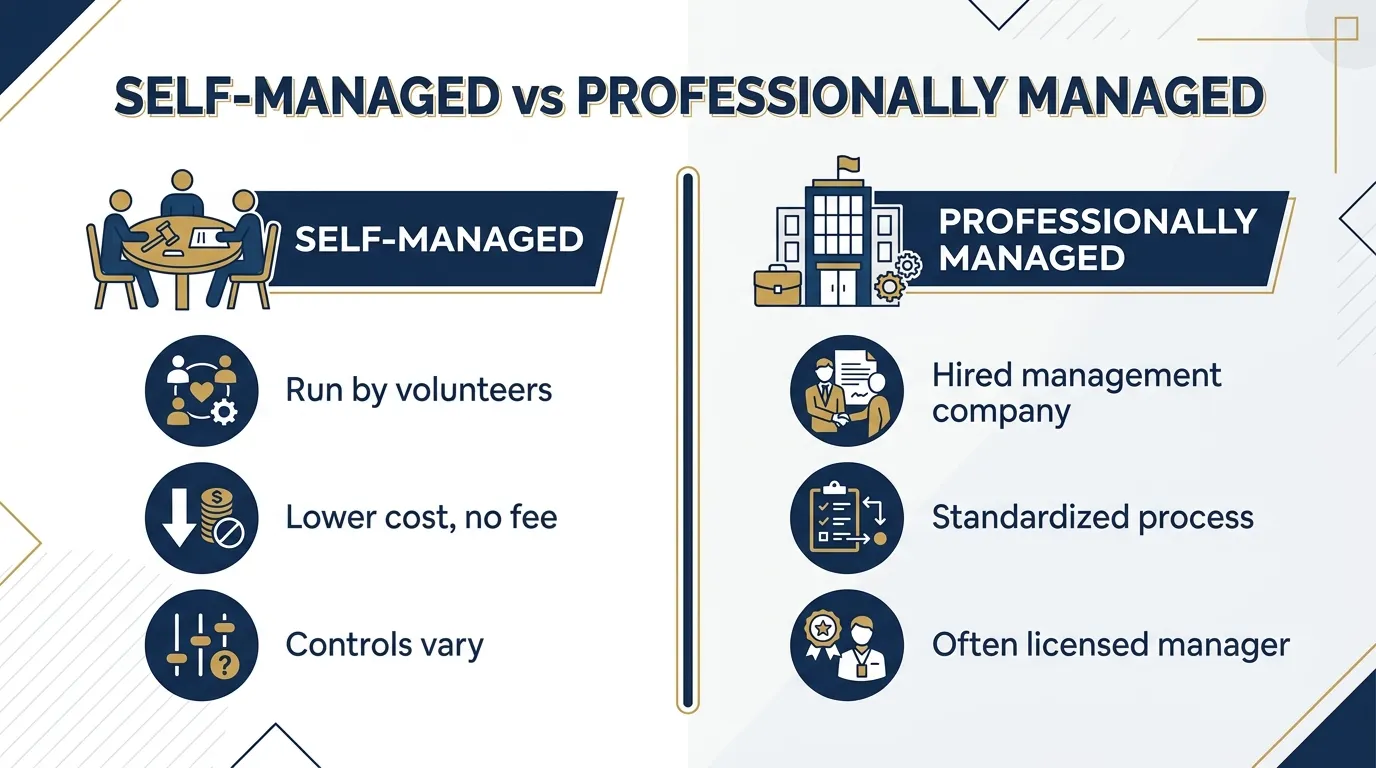
A self-managed HOA is operated by its volunteer board. A professionally managed one contracts a management company to handle day-to-day finances, documents, vendors, and compliance.
Every HOA is governed by a board of unpaid, elected owners. The difference is who does the operational work underneath that board.
In a self-managed association, the board does it all: collecting dues, paying bills, keeping the books, hiring and supervising vendors, producing financial statements and meeting minutes, tracking insurance, fielding owner complaints, and turning around the documents a buyer's lender needs at closing. It is volunteer labor, and the quality depends heavily on who happens to be serving.
In a professionally managed association, the board hires a community association management company and delegates that operational work. The manager handles bookkeeping and reporting, dues collection and delinquency follow-up, vendor bids and oversight, compliance calendars, and document production, while the board keeps decision-making authority and fiduciary responsibility. The board still sets the budget and votes; the manager executes and advises. According to management firms, the value a professional adds is financial-planning and reserve expertise, current knowledge of changing laws, established vendor relationships, and time. The trade-off is cost, which owners pay through dues.
How Common Is Each, and Why It Matters to a Buyer
Of roughly 373,000 U.S. community associations, the large majority are professionally managed; somewhere around a quarter are self-managed, more often small associations.
There are about 373,000 community associations in the United States, home to roughly 77 million residents, or about a third of the housing stock, according to the Foundation for Community Association Research. Industry surveys put the large majority of those associations under professional management, with self-managed associations estimated at roughly one in four, concentrated among smaller communities where the budget cannot easily absorb a management fee.
That is the heart of why the structure matters to a buyer. Self-management correlates with small size, and small associations have thinner budgets, fewer owners to share special assessments across, and less administrative capacity. None of that is fatal. A 12-unit building with engaged owners and a careful treasurer can be financially healthier than a 300-unit tower with a disengaged board and a stretched manager. But the structure tells you where to point your due diligence: in a self-managed association, the controls and documentation you would normally expect a professional to maintain may or may not exist, and that is exactly what you need to verify.
Is a Self-Managed HOA a Red Flag?
Not on its own. Self-management is a reason to look closer at documents, controls, and reserves, but a small, stable, well-run association can be a perfectly sound buy.
The honest answer is no, self-management is not a red flag by itself. It is a prompt to verify things you might otherwise take for granted. Plenty of self-managed associations are run beautifully by owners who treat it like the small business it is: clean books, current reserve study, minutes that actually record decisions, dues set to fund the building properly. Those communities also avoid a management fee, which leaves more of every dues dollar for reserves and maintenance.
The risk is variance. Professional management does not guarantee competence, but it does impose a floor: standardized accounting, a compliance calendar, document templates, and in many states a licensed manager with a fiduciary duty and a regulator. A self-managed association has no such floor. It can be excellent or it can be a treasurer's shoebox of receipts, and the only way to tell is to read the documents. The structure raises the value of due diligence; it does not replace it. The genuine red flags, missing reserve studies, sloppy or absent minutes, no audited financials, no clear signatory controls, are red flags in any association. They just turn up more often where no professional is minding them.
Document Quality and the Closing Clock
Resale and estoppel documents are due on a statutory clock regardless of management type. Self-managed boards more often miss it or deliver incomplete packets.
This is where management structure most directly touches your transaction. To close, your lender needs the association's financials, budget, reserve study, insurance certificate, and a resale or estoppel certificate confirming there are no unpaid dues or pending assessments attached to the unit. Many states put that delivery on a hard clock. In Florida, an association must issue an estoppel certificate within 10 business days of a request. In Virginia, the resale certificate is due within 14 days, and if it is not delivered it can be deemed unavailable, with consequences for the deal.
Critically, those deadlines bind the association, not its manager. There is no statutory extension for being self-managed. A professionally managed association usually has a defined process and a person whose job is to turn these around. In a self-managed association, as one resale-services firm puts it, "there may be no structured process at all," and the request can sit until a volunteer has a free evening. The practical result is slower and sometimes incomplete packets, which can delay or jeopardize a closing.
Document quality follows the same pattern. Meeting minutes that actually record votes, financial statements prepared consistently, a reserve study that is current rather than a decade old: these are the raw material of your due diligence, and they tend to be more complete where a professional maintains them. When they are thin, that is information too. Our guides on getting HOA documents before you make an offer and what is inside a resale certificate cover what to request and how to read it.
Financial Controls and Fraud Risk
Self-managed associations concentrate financial control in a few volunteers. Without dual signatures and independent review, embezzlement is a documented and recurring risk.
The single largest structural difference in risk is financial control. In a self-managed association, the people writing the checks, reconciling the accounts, and reporting to owners are often the same one or two volunteers, with no independent review. The Community Associations Institute warns that in many self-managed associations only the treasurer knows the bank names and account numbers, which makes both oversight and recovery difficult if something goes wrong. The recommended controls, dual signatures on transfers, never signing blank checks, accounts held only in the association's name, are easy to skip when one trusted neighbor handles everything.
When those controls are missing, the losses are real. In Aspen, Colorado, a bookkeeper for the Burlingame Ranch I condominium association admitted to embezzling about $183,000 before repaying roughly $201,500 once the board discovered it. In Utah, the treasurer of the Lava Bluff HOA pleaded guilty to stealing more than $232,000 over roughly six years, moving association money to personal accounts and forging board members' signatures. Professional management is not immune to fraud, but a reputable firm typically carries fidelity insurance, segregates duties, and faces an external audit, layers a single volunteer treasurer usually does not. For a buyer, the question is not "is it self-managed?" but "who can move this association's money, and who checks them?" The minutes and financials usually answer it. A free read of the meeting minutes can surface how the board discusses money and controls.
Reserve Discipline and Financial Health
Reserve-study and funding duties apply regardless of management type. The risk in self-managed associations is execution, not the legal requirement.
Most states impose reserve obligations on the association no matter who manages it. California requires a reserve study with a visual inspection at least every three years; Nevada and Virginia require one at least every five years; Washington requires an annually updated study; and Florida now mandates a Structural Integrity Reserve Study for buildings three or more stories and bars owners from voting to underfund structural reserves. The legal duty is identical for a self-managed building. What differs is execution: a professional manager typically owns the compliance calendar and pushes the board to commission and fund the study, while a self-managed board has to remember and prioritize it without a paid prompt.
That is why the reserve numbers matter more than the management label. Pull the reserve study and check percent funded, the actual reserve balance divided by the fully funded balance: above 70% is strong, 30% to 70% is fair, and below 30% is at risk of a special assessment. By the analysis of more than 100,000 studies by Association Reserves, about 74% of associations are less than 70% funded, a problem that has nothing to do with whether a manager is involved. Our reserve fund guide and how to read a reserve study walk through the math. A thinly funded reserve in a self-managed building is the same financial risk it would be anywhere; you simply have to check it yourself rather than assume someone is watching.
Does the Manager Have to Be Licensed in My State?
In several states a paid community association manager must be licensed or certified. Volunteer-run self-managed boards generally sit outside those licensing regimes.
If the association pays a management company, several states require that manager to hold a license or certificate, which adds a layer of accountability and a regulator that a self-managed board does not have. The rules vary widely.
| State | Paid manager licensed? | Authority |
|---|---|---|
| Florida | Yes. A paid community association manager needs a CAM license; firms managing more than 10 units or a budget of $100,000 or more must also be licensed. | Fla. Stat. §§468.431–468.438 (DBPR) |
| California | No state license required. Certification (CCAM, PCAM) is voluntary. | Davis-Stirling Act |
| Nevada | Yes. Community managers must hold a certificate. | NRS Chapter 116A |
| Virginia | Yes. Management firms must be licensed; key employees must be certified. | Va. Code §54.1-2346 et seq. |
| Illinois | Yes. Community association managers must be licensed. | 225 ILCS 427 |
| Colorado | No. The state's manager-licensing program expired in 2019 and has not been reinstated. | Program lapsed 6/30/2019 |
The key point for a buyer: these regimes regulate paid managers. A volunteer board running a self-managed association generally falls outside them entirely, so the licensing floor that catches a professional manager, exams, fiduciary standards, a complaint process, does not apply to the neighbors handling the money. That is not a reason to avoid self-managed buildings, but it is a reason to lean harder on the documents, because the external accountability layer is thinner. Confirm the current rule for your state, as licensing statutes change and some carry sunset dates.
What to Check Either Way
Read the reserve study, financials, and minutes; confirm signatory controls and insurance; and check how fast the resale packet arrives. The structure points your attention; the documents give the verdict.
Whether the association is self-managed or professionally managed, the same short list tells you what you are buying into:
- Pull the reserve study and calculate percent funded. Below 30% is a serious warning in any building. A missing or stale study is itself a flag, and more common where no professional maintains the calendar.
- Read several years of financial statements. Look for consistency, a real reserve contribution, and ideally an external audit or review. Our guide to reading HOA financials shows what matters.
- Check who can move the money. Bylaws or minutes should show dual-signature controls on transfers and that accounts are in the association's name. Concentrated, unchecked control over funds is the core fraud risk.
- Read the meeting minutes. They reveal how decisions get made, whether issues recur, and whether the board is functioning, regardless of who keeps them. See red flags in HOA meeting minutes.
- Time the document turnaround. How quickly the resale or estoppel packet arrives is a live test of operational capacity, and a slow one can threaten your closing date.
- Confirm insurance and, if managed, the manager. Verify current master-policy coverage, and if there is a management company, that it is licensed where the state requires it and carries fidelity coverage.
Management structure is a lens, not a label. It tells you where the risks are most likely to hide. The documents tell you whether they are actually there, and unlike a management brochure or a confident board president, the documents do not oversell.
Frequently Asked Questions
Is it bad to buy into a self-managed HOA?
Not inherently. A small, stable, well-run self-managed association can be a sound buy and often costs less in dues because there is no management fee. The risk is variance: self-managed associations have no standardized floor for accounting, compliance, or financial controls, so quality depends entirely on the volunteers serving. Treat self-management as a reason to read the documents carefully, not as a disqualifier.
What percentage of HOAs are self-managed?
Industry surveys estimate that roughly one in four U.S. community associations is self-managed, with the large majority professionally managed. Self-management is concentrated among smaller associations whose budgets cannot easily absorb a management company's fee. There are about 373,000 community associations nationwide, according to the Foundation for Community Association Research.
Do self-managed HOAs have to follow the same laws?
Yes. State requirements for reserve studies, budgets, financial reporting, and resale or estoppel document delivery apply to the association itself, regardless of whether it hires a manager. There is generally no statutory extension or exemption for being self-managed. The difference is operational: a self-managed board has to execute those duties without a paid professional managing the calendar.
Are self-managed HOAs more at risk of fraud?
They can be, because financial control is often concentrated in one or two volunteers with no independent review or audit. Documented cases include an Aspen, Colorado association that lost about $183,000 to a bookkeeper and a Utah HOA whose treasurer stole more than $232,000. The protection is not management type but controls: dual signatures on transfers, accounts only in the association's name, and an external audit. Confirm those exist before you buy.
Does an HOA manager have to be licensed?
It depends on the state. Florida, Nevada, Virginia, and Illinois require paid community association managers to be licensed or certified; California and (since 2019) Colorado do not. These rules regulate paid managers only, so a volunteer-run self-managed board generally sits outside them. Always confirm the current statute for your state, as licensing laws change.
How much does HOA management cost?
Management fees are commonly quoted in a range of roughly $10 to $20 per unit per month for typical service, and higher for full-service or premium contracts, paid through dues. Whether professional management is "worth it" depends on the association's size and complexity; small communities sometimes self-manage specifically to keep that cost out of dues and direct more toward reserves.
Get Your HOA Documents Analyzed
GoverningDocs analyzes CC&Rs, reserve studies, and meeting minutes, identifying red flags, restrictions, and financial risks so you can buy with confidence. Free. No signup required.
Your first full property report is also free. See what you'll get →
Or get your first full report free →Related Articles
Sources & References
- Foundation for Community Association Research (373,000 U.S. community associations, roughly 77 million residents, 2025)
- FirstService Residential (what professional management provides; self-management trade-offs)
- Community Associations Institute (fraud-prevention controls; single-treasurer exposure in self-managed associations)
- Aspen Daily News (Burlingame Ranch I, ~$183,000 bookkeeper embezzlement)
- IRS Criminal Investigation (Lava Bluff HOA treasurer, >$232,000 embezzlement guilty plea)
- Fla. Stat. §718.116 (estoppel certificate, 10 business days)
- Va. Code Title 55.1, Ch. 23.1 (resale certificate, 14-day delivery)
- Fla. Stat. §§468.431–468.438 (community association manager and firm licensing)
- NRS Chapter 116A (Nevada community manager certification)
- Va. Code §54.1-2346 (Virginia common interest community manager licensing)
- 225 ILCS 427/15 (Illinois Community Association Manager Licensing Act)
- Association Reserves (74% of associations are less than 70% funded, 100,000+ studies)
Disclaimer: This article is for educational purposes only and does not constitute legal, financial, or real estate advice. Manager-licensing rules, reserve and resale requirements, and document-delivery deadlines vary by state and by the specific association, and the examples cited are reported situations, not legal conclusions. Statutes referenced are current as of June 2026 and may be superseded. Consult a qualified real estate attorney or your lender for guidance specific to your situation.