
In This Guide
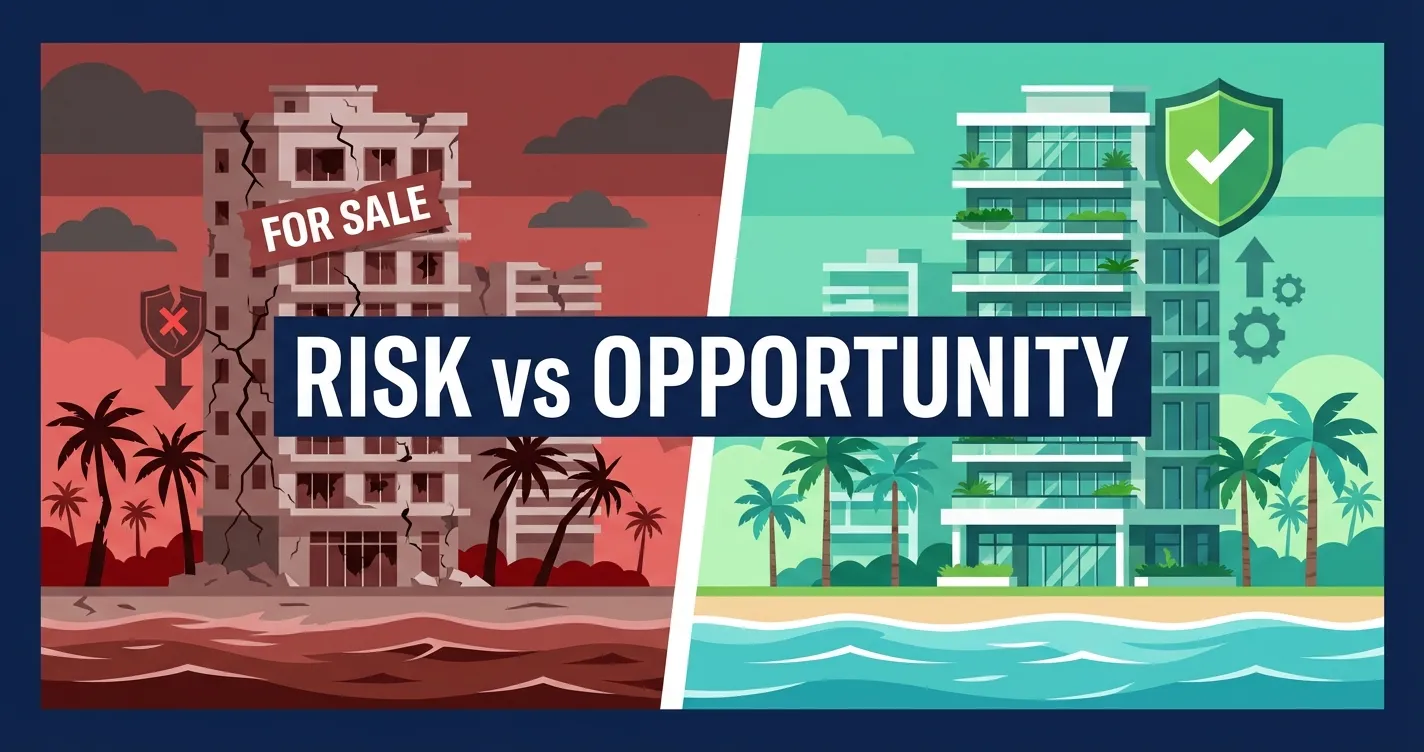
Florida's condo crisis creates opportunities for informed buyers. SIRS-compliant, well-funded buildings hold value. Distressed properties may offer discounts but can carry six-figure special assessments per unit.
South Florida condos over 30 years old lost 21% of their average sale price between 2023 and late 2024. In January 2025, South Florida had about 11 months of condo inventory for sale. Sellers are desperate. If you're an investor or buyer watching from the sidelines, this looks like a fire sale.
But cheap doesn't mean safe. The same forces pushing prices down (SIRS requirements, special assessments, insurance spikes) can turn a "bargain" into a six-figure liability. 92% of Miami-Dade condo sellers got less than asking price in 2025. Some of those sellers were cutting their losses after getting hit with assessments they couldn't absorb.
The opportunity is real. So is the risk. The difference between a smart buy and a disaster comes down to knowing which buildings have already done the hard work and which ones are still pretending the bill isn't coming.
The Current Market Reality
Florida's condo market is in a buyer's market driven by post-Surfside safety laws, rising insurance, and mandatory reserve funding that applies to budgets adopted on or after December 31, 2024.
The numbers paint a clear picture. Condos over 30 years old in South Florida have dropped 21% in average sale price between 2023 and the third quarter of 2024, according to an ISG World study. In Miami-Dade County, 92% of condo sellers got less than their asking price. In January 2025, South Florida had about 11 months of condo inventory (about 10 months in Palm Beach County, 12.5 in Miami-Dade), well above the 6 months that signals a balanced market.
Three forces are driving this simultaneously. First, the SIRS deadline, extended by HB 913 (2025), passed on December 31, 2025, and many buildings were behind long before it. A February 2025 Miami Realtors report found that about 62% of South Florida condo associations had not finished the study by the original December 31, 2024 deadline (56% in Miami-Dade). Second, for budgets adopted on or after December 31, 2024, owners in a building that must have a SIRS can no longer vote to skip or cut the reserves for its structural items, with a few narrow exceptions (Fla. Stat. 718.112(2)(f)). Boards that had been deferring contributions for years now have to start funding. Third, insurance premiums have soared in Florida, and associations pass that cost to owners. Redfin found median condo HOA dues up about 16% in a year in Fort Lauderdale and 17% in Tampa (three months ending July 2024).
The result: a flood of motivated sellers who either can't afford the assessment or don't want to wait around for it. Miami-Dade County had to create a 0% interest loan program so eligible owners could borrow up to $50K just to cover their assessment obligations. The county paused the program in August 2025 and has since relaunched it, with priority for seniors 62 and older. Check the county page for the current application window.
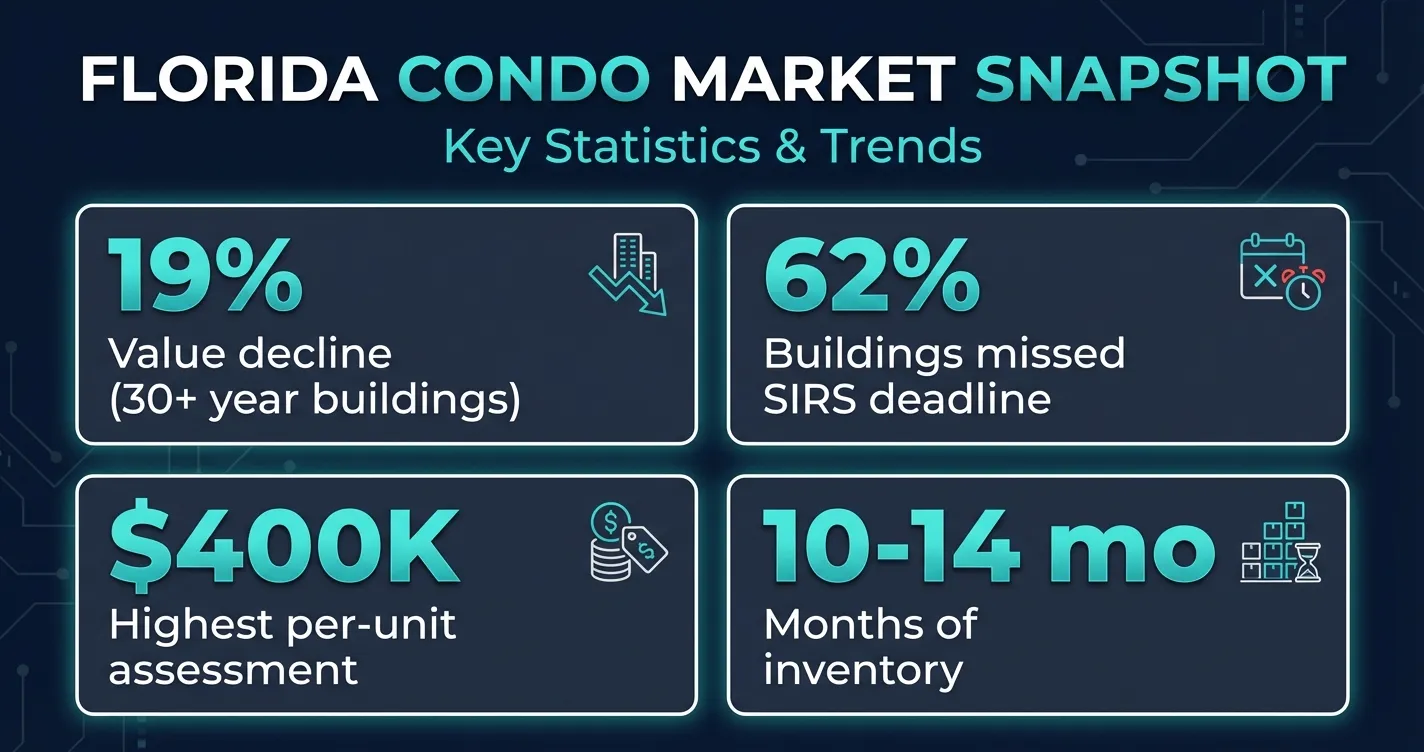
Key market indicators for Florida's condo market in 2026
The Risk-Opportunity Matrix
Not all Florida condos carry the same risk. SIRS compliance status and reserve funding level create four distinct categories of investment opportunity.
Every Florida condo you evaluate falls into one of four buckets. Where it lands determines your risk, your financing options, and your likely return.
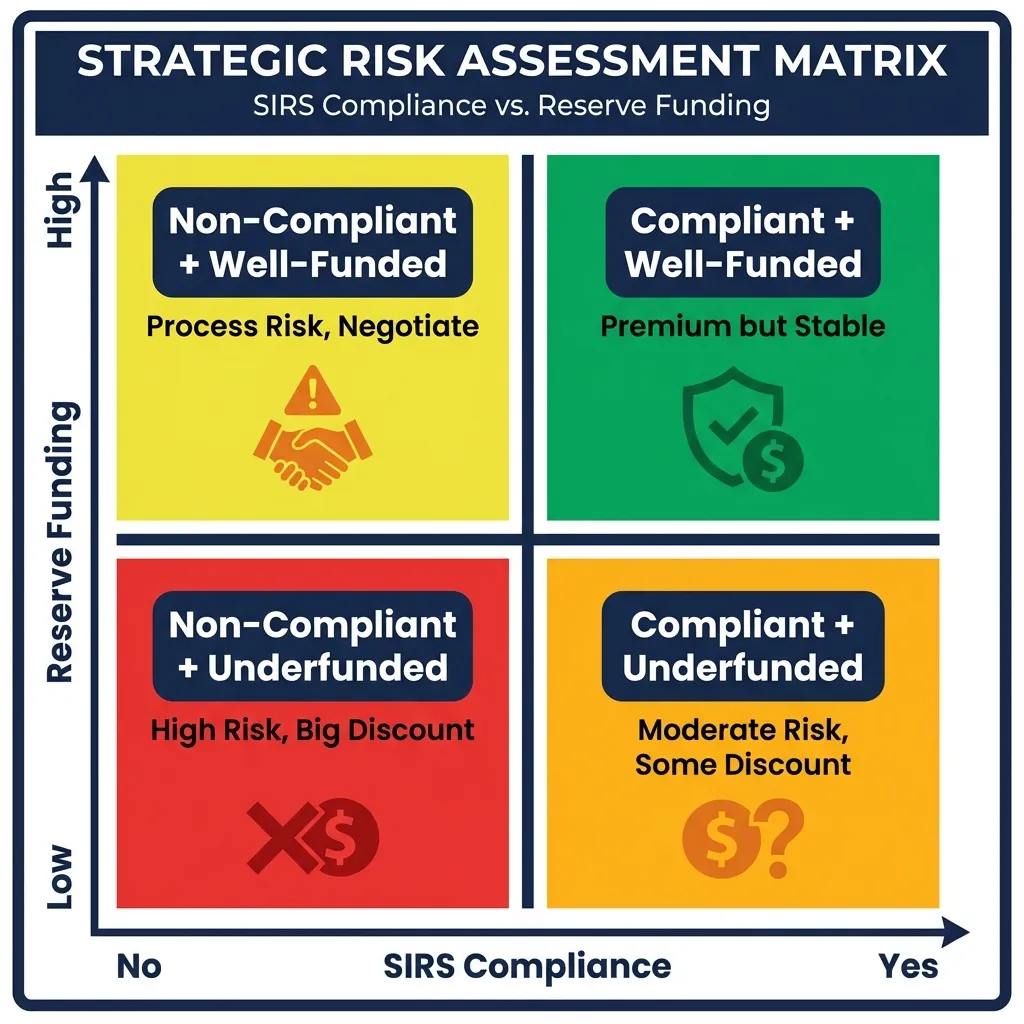
Four categories of Florida condo investment based on compliance and funding
| Category | Risk Level | Illustrative Discount | Financing |
|---|---|---|---|
| Compliant + Well-Funded | Low | Minimal (5-10%) | Conventional available |
| Compliant + Underfunded | Moderate | 10-20% | Conventional possible, check reserves |
| Non-Compliant + Well-Funded | Elevated | 15-25% | May need portfolio lender |
| Non-Compliant + Underfunded | High | 25-40%+ | Cash only in most cases |
Discount ranges are illustrative estimates of how price tends to track risk, not published market data. Check recent sales in the building itself.
The Sweet Spot: Compliant Buildings with Temporary Discounts
The most interesting category for informed buyers is buildings that have already completed SIRS compliance and funded their reserves but are still trading at a discount because the broader market hasn't caught up. These buildings did the hard work. They absorbed the assessment. The sellers who couldn't handle it have already left. What remains is a building on the other side of the worst.
Look for buildings where the SIRS report is complete, reserves are above 50% funded, and the board has a multi-year funding plan in place. These properties are priced like the crisis is still happening but the actual financial risk has already been addressed.
How to Identify SIRS-Compliant Opportunities
Check MyFloridaLicense.com for SIRS filing status, then request the actual reserve study to verify funding levels. Buildings that completed compliance early are often the best opportunities.
Start with the public record. Florida's DBPR (Department of Business and Professional Regulation) database shows whether a condo association has filed its SIRS report. This is your first filter. If the building hasn't filed, you know you're dealing with a non-compliant property and should price accordingly.
But filing alone isn't enough. A building can file a SIRS report and still be critically underfunded. Our analysis of 70+ Florida SIRS reports found a bimodal distribution: 65% of buildings were at or near 100% funded, while 27% were critically underfunded below 30%. Almost nothing in the middle. Buildings either took it seriously or they didn't.
After confirming SIRS filing status, request these documents:
- The SIRS report itself (not just the filing confirmation). Check percent funded, components at end of useful life (RUL=0), and the recommended annual contribution.
- Milestone Inspection report (required for condo buildings three stories or taller by the end of the year they turn 30, or 25 where the local building department requires it, for example near salt water, under Fla. Stat. 553.899). This is the structural engineering assessment. Look for any findings of "substantial structural deterioration," which the building has to schedule repairs for.
- Board meeting minutes (last 24 months). Search for anything "tabled" or "deferred." This is where you find the gap between what the SIRS report recommends and what the board actually does.
Evaluating Distressed Properties
The listed price is never the true cost. Add the likely special assessment, insurance increase, and deferred maintenance to calculate your real basis in the property.
When a Florida condo is priced 30-40% below comparable units in the area, there's a reason. Your job is to figure out whether that reason is priced into the discount or not.
Calculate the True Cost
Purchase price + likely assessment + insurance premium increase + deferred maintenance share = your real basis.
Start with the reserve study. If the building is 30% funded and needs $5M in reserves, the gap is $3.5M. Divided across 100 units, that's $35,000 per unit that has to come from somewhere. Either through a special assessment, a dues increase, or a combination of both. That number gets added to your purchase price.
Then check insurance. Florida condo insurance has been one of the biggest cost drivers. Some buildings have seen their premium jump sharply at a single renewal. That cost gets passed to unit owners through HOA fees. Ask for the last three years of insurance renewals to see the trend.
Financing Considerations
Fannie Mae will not back loans in a condo building that needs critical repairs, failed a required safety inspection, has thin reserves, or has too many owners behind on dues. A building that fails these checks is usually limited to cash or portfolio loans.
Financing is where the crisis hits hardest. Before Fannie Mae will buy a loan on a condo, the lender has to review the building. Under Fannie Mae's rules, a building is ineligible if it needs critical repairs or failed a required structural inspection. A full review also checks that reserve funding is at least 10% of the budget (15% for loan applications on or after January 4, 2027, under Lender Letter LL-2026-03) and that no more than 15% of units are 60 or more days behind on dues. If the building fails these checks, it becomes non-warrantable. That usually means no conventional mortgage. Freddie Mac sets its own condo rules, so ask your lender which ones apply to your loan.
Non-warrantable status triggers a death spiral that we're already seeing play out across the state. As of April 2025, 1,438 Florida condo buildings were on Fannie Mae's list of projects it won't back, according to data from the law firm Allcock Marcus reported by the Tampa Bay Times. The most common reason was inadequate property insurance, followed by deferred maintenance and unmet critical repairs. Once a building is on that list, many lenders won't lend there. The buyer pool shrinks to cash buyers and portfolio lenders. Fewer buyers means lower prices. Lower prices mean less equity for current owners to absorb the assessment. More owners sell at a loss. Prices drop further.
The Cash Buyer Advantage
If you're buying cash, this is where the biggest discounts live. Non-warrantable buildings have fewer competing buyers, more motivated sellers, and less price support. But the risk is proportional. You're buying into a building that may not be financeable for years. Your exit depends on the building regaining warrantable status, which depends on the board fixing the problems that caused the designation in the first place.
For financed buyers, focus on SIRS-compliant buildings with reserves above 10% of the annual budget (Fannie Mae's current minimum; it rises to 15% for loan applications taken on or after January 4, 2027, under Lender Letter LL-2026-03). Ask your lender to run a warrantability check early in the process. Don't wait until underwriting to find out the building doesn't qualify.
Check Your Building's Financial Health
Upload your HOA's reserve study and get instant analysis of percent funded, deferred maintenance, and special assessment risk. Free. No signup required.
Your first full property report is also free. See what you'll get →
Or get your first full report free →Geographic Opportunities
Compliance rates vary dramatically by region. Markets with the lowest compliance tend to have the most motivated sellers and the biggest discounts, but also the highest risk.
Not all Florida markets are equally affected. In the February 2025 Miami Realtors report, the share of associations that had finished the study ranged from about 28% in Palm Beach County to 44% in Miami-Dade, per Condo Vultures. The markets where compliance is lowest tend to have older building stock, less institutional ownership, and boards that were slower to act.
| Market | Opportunity Type | Key Factor |
|---|---|---|
| Miami-Dade / Broward | Highest volume of distressed inventory | Oldest building stock. Most assessments in progress. |
| Palm Beach | Low compliance (~28%), motivated sellers | Luxury and mid-tier mix. Higher price points. |
| Orlando / Central FL | Newer stock, fewer SIRS requirements | Less crisis impact. Steady rental demand. |
| Tampa Bay / Gulf Coast | Post-hurricane rebuilds, insurance challenges | Some buildings completed repairs. Recovery play. |
| Southwest FL (Cape Coral, Fort Myers) | Value markets with motivated sellers | Post-Ian recovery. Lower price points. Cash buyer territory. |
Market conditions as of early 2026. Verify current data before making investment decisions.
The best geographic strategy depends on your buyer profile. Financed buyers should focus on Orlando and Central Florida where SIRS impact is minimal and conventional loans are still available. Cash buyers with higher risk tolerance can find the biggest discounts in Miami-Dade, Broward, and Palm Beach.
Due Diligence Checklist for Investors
Seven documents and data points every Florida condo investor must check before making an offer.
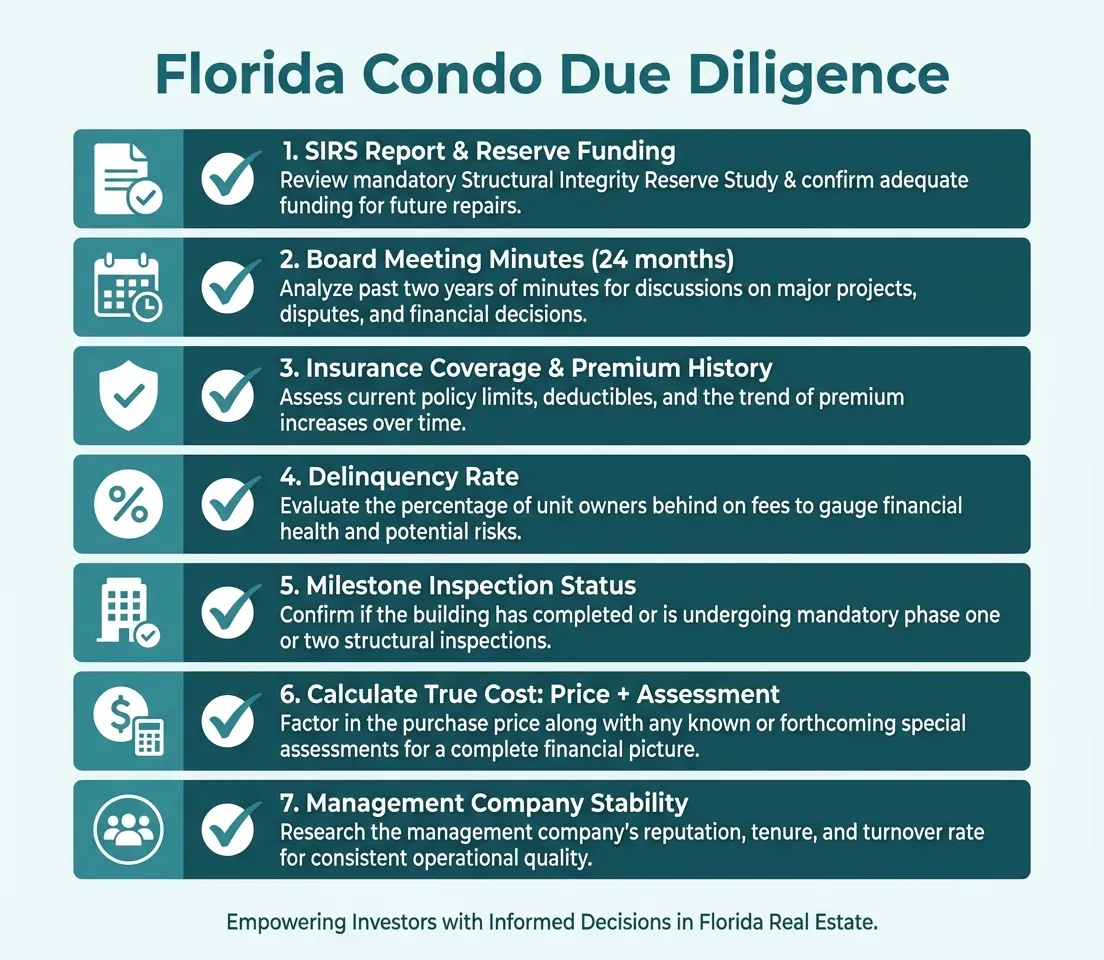
Complete due diligence checklist for Florida condo investments
Before You Make an Offer:
- SIRS report and reserve funding analysis. Check percent funded (below 50% is danger zone), RUL=0 components, and recommended vs actual annual contribution.
- Board meeting minutes (last 24 months). Search for "tabled," "deferred," "assessment," "litigation." Deferred repairs don't disappear. They compound.
- Insurance coverage and premium history. Request the last 3 years of master policy renewals. Look for coverage reductions, carrier changes, or non-renewal notices.
- Delinquency rate. Above 15% is a red flag for both building financial health and Fannie Mae warrantability. Ask the management company directly.
- Milestone Inspection status. For condo buildings three stories or taller that are 30 or older (25 where the local building department requires it), confirm the milestone inspection is complete and check for any "substantial structural deterioration" findings.
- True cost calculation. Purchase price + likely assessment + insurance increase + deferred maintenance. If this number exceeds comparable compliant units, the discount isn't real.
- Management company stability. Has the management company changed recently? Frequent turnover is a sign of board dysfunction or financial problems that scare off professional managers.
When to Walk Away
Some buildings are bargains. Others are traps. Five signs that a distressed condo is not worth the risk at any price.
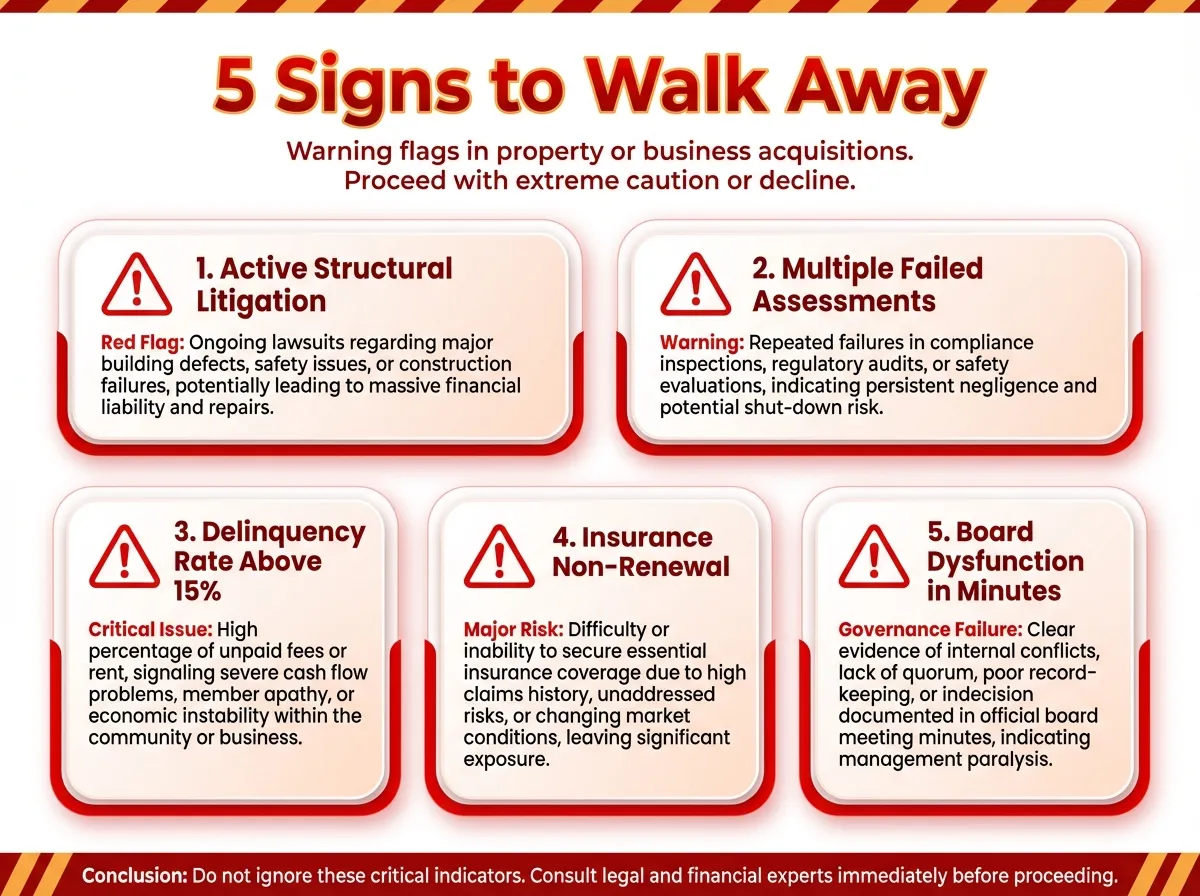
Red flags that should make you walk away from any deal
Active structural litigation. If the building is suing the developer, a contractor, or its own board over structural defects, the outcome is unpredictable and the timeline is long. Litigation can freeze insurance, prevent financing, and tank resale value for years.
Multiple failed assessments. If the board has attempted to levy assessments and owners have refused to pay or voted them down, the building has a governance problem that no amount of discount can fix. The repairs still need to happen. The money still isn't there. And now there's a track record of non-compliance.
Delinquency rate above 15%. This is both a Fannie Mae disqualifier and a signal of broader financial distress. When more than 15% of owners aren't paying their dues, the building can't fund basic operations, let alone reserves.
Insurance non-renewal. If the building's master policy has been non-renewed and they're operating on surplus lines or have gaps in coverage, the building is effectively uninsurable at standard rates. This makes it non-warrantable and creates massive liability exposure for every owner.
Board dysfunction in the minutes. If meeting minutes show a revolving door of board members, shouting matches, failed quorums, or a board that consistently overrides professional recommendations from their reserve study firm or engineer, the building's problems are governance problems. Money alone won't fix them.
Check Your Building's Financial Health
Upload your HOA's reserve study and get instant analysis of percent funded, deferred maintenance, and special assessment risk. Free. No signup required.
Your first full property report is also free. See what you'll get →
Or get your first full report free →Frequently Asked Questions
Is now a good time to buy a Florida condo?
It depends on the building, not the market. SIRS-compliant buildings with healthy reserves are trading at temporary discounts because the broader market is depressed. These can be good opportunities. Non-compliant buildings with unknown assessment exposure are not bargains regardless of price.
How do I check if a Florida condo is SIRS compliant?
Start with the Florida DBPR database at MyFloridaLicense.com to check filing status. Then request the actual SIRS report from the association to verify the findings and funding levels. Filing alone does not mean the building is adequately funded.
What is a non-warrantable condo?
A condo that doesn't meet Fannie Mae or Freddie Mac eligibility requirements for conventional financing. Common reasons include reserve funding below 10% of the annual budget (15% for loan applications on or after January 4, 2027), delinquency rates above 15%, active litigation, or insurance coverage gaps. Non-warrantable buildings can only be purchased with cash or portfolio loans.
How much are Florida condo special assessments in 2026?
Assessments vary widely depending on the building's condition and size. At the high end they reach six figures: owners at Palm Bay Yacht Club in Miami have had to pay $140,000 each toward a special assessment, according to NBC News, and assessments at Mediterranean Village in Aventura were reported as high as $400,000 per unit. The reserve study will tell you how much the building needs.
Can I get a mortgage on a Florida condo right now?
Yes, if the building is SIRS compliant, has adequate reserves, current insurance, and low delinquency. Many buildings still qualify for conventional loans. But a growing number are falling out of compliance, which limits financing to cash or portfolio lenders. Ask your lender to run warrantability early.
When will Florida's condo market recover?
Recovery is expected to be building-by-building, not market-wide. Compliant buildings with completed repairs will likely stabilize first, potentially by late 2026. Non-compliant buildings may take years longer as they work through assessments, repairs, and regaining warrantable status.
Sources & References
- South Florida condo owners dumping homes after six-figure assessments, Yahoo Finance, reporting the Wall Street Journal (owners selling after six-figure assessments)
- Prices have collapsed for South Florida condos 30 years or older, Bisnow, Oct 25, 2024, reporting an ISG World study (average sale prices for 30+ year old condos down 21% from 2023 to Q3 2024)
- 62% of South Florida condo associations had not completed a SIRS by the Dec. 31, 2024 deadline, Condo Vultures / Miami Association of Realtors (Feb 2025; also the January 2025 months-of-supply figures)
- Homebuyers scored the biggest discounts in more than a decade in 2025, ConsumerAffairs (92% of Miami sellers below asking)
- Number of Florida condos on mortgage blacklist is growing, Newsweek, Apr 14, 2025, citing Allcock Marcus data reported by the Tampa Bay Times (1,438 Florida buildings on Fannie Mae's list)
- Aventura condo owners face unprecedented special assessments, Brosda & Bentley (Mediterranean Village, up to $400K/unit)
- Condo HOA fees surge in Florida amid insurance crisis, Redfin, Aug 22, 2024 (HOA dues up 16-17% in Fort Lauderdale and Tampa)
- B4-2.1-03, Ineligible Projects, Fannie Mae Selling Guide (critical repairs, failed inspections)
- B4-2.2-01, Full Review Process, Fannie Mae Selling Guide (10% reserves, 15% delinquency)
- Lender Letter LL-2026-03, Fannie Mae (15% reserves for applications on or after Jan 4, 2027)
- Fla. Stat. 553.899, Florida Legislature (milestone inspections)
- Condominium Special Assessment Program, Miami-Dade County ($50K 0% interest loans)
- Florida Senate Bill 4-D (2022), Florida Senate (SIRS requirements)
- Florida House Bill 913 (2025), Florida House of Representatives (buyer protections)
Proprietary statistics (reserve funding distribution, component analysis) are based on GoverningDocs analysis of 70 Florida SIRS reports. All other statistics are sourced from the publications listed above. This article is for informational purposes only and does not constitute legal or financial advice.