In This Guide
The best HOA document analysis software depends on what you are buying and how fast you need an answer. Domain-specific AI tools handle 200+ page packets in minutes with source citations. Attorney review costs $500-$2,000 and takes days. ChatGPT is free and unreliable. Below: five approaches compared head to head.
A typical condo resale package runs over 200 pages: CC&Rs, bylaws, reserve study, two years of meeting minutes, financial statements, an audit, an insurance certificate, the rules and regulations, and a stack of state-specific forms. The seller's management company needs 5 to 14 calendar days to assemble it. Once you receive it, the cancellation clock starts. Texas gives a condo buyer six days. Washington five. Virginia three.
That is the buyer's problem. A document set engineered to be exhaustive, in a window engineered to be short. The market response over the last two years has been a wave of software, services, and AI tools all promising to read the package for you. Some are excellent. Some are dangerous. This is the comparison.
Why Generic Tools Fall Short on HOA Documents
HOA packets need cross-document analysis, statute-aware reading, and benchmarks against comparable properties. Generic AI does none of that.
Three things make HOA document review structurally different from generic document review.
First, cross-document analysis. A red flag in HOA documents almost never lives in one place. A reserve study saying 22% funded is meaningful only when paired with the meeting minutes showing the board voted to defer roof replacement and the financial statements showing the reserve transfer line is below 10% of operating budget. Tools that read one document at a time miss the pattern.
Second, domain-specific judgment. A 22% funded reserve is weak under Association Reserves' tier framework. Five percent of units 60+ days delinquent is normal. Sixteen percent breaks FHA, Fannie, and Freddie warrantability. A generic summarizer cannot tell you which numbers cross which thresholds because it has no benchmark.
Third, hallucination cost. Recent benchmarks show large language models fabricate citations 15-20% of the time on general topics and 35-55% on niche or recent ones. A 2024 study found 56% of academic-style references generated by GPT-4o contained errors, and roughly 1 in 5 were entirely fabricated. When the document at issue is a legally binding CC&R and the decision is whether to spend $600,000, that error rate is not acceptable.
The Five Approaches Compared
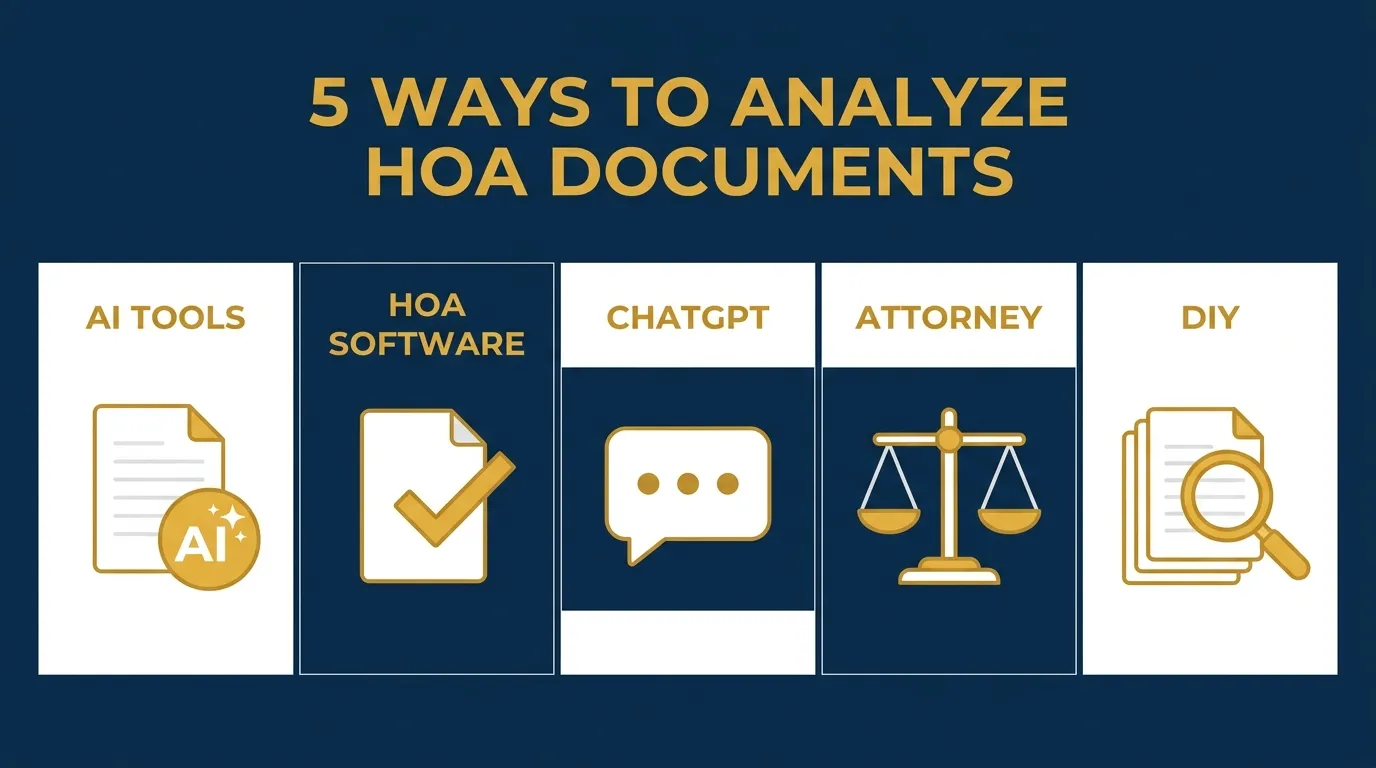
Five categories of HOA document review exist in 2026: domain-specific AI, HOA-management software, ChatGPT, attorney review, and DIY.
1. Domain-specific AI for buyers (GoverningDocs)
GoverningDocs is built specifically for buyers and their agents. The model is trained on 1,900+ HOA documents, runs cross-document analysis (reserve study + minutes + financials + CC&Rs together), and produces 25+ report types tied to specific decisions: warrantability, rental restrictions, special-assessment risk, financial health, FHA/VA red flags. Every finding links to a page citation in the source PDF. Free tools cover CC&R analysis, reserve studies, and meeting minutes. The full $39 report adds an A-F health grade, a Q&A chatbot, and coverage tracking that flags what was missing from the package. Turnaround: 15 minutes for free tools, under 24 hours for the full report.
2. Other specialized HOA software
A handful of other tools have shipped in the last two years. Eli Report is the closest direct competitor on the buyer ICP, with 10,000+ reports across the US and Canada and paid options available beyond a free tier. Eli's strongest coverage is BC strata and Ontario condo. HeyNeighbor.AI targets HOA boards and managers rather than buyers, with a Q&A chatbot trained on a building's own documents. Rexera (formerly InspectHOA, acquired by RealPage in July 2025) automates HOA document retrieval and condo questionnaires for lenders and title agents, not retail buyers. CIDA produces a premium-priced human-analyst report with a proprietary risk score and multi-day turnaround.
3. ChatGPT and other general AI
ChatGPT, Claude, Gemini, and Perplexity can summarize a single uploaded document and answer follow-up questions. They are free or cheap, fast, and surprisingly competent on plain-language summary tasks. They are also poorly suited to HOA due diligence: no cross-document reasoning across a multi-PDF package, no benchmarking against comparable buildings, no source citation that can be verified at the page level, and a non-trivial hallucination rate on statute citations. We covered the specific failure modes in our deeper post on why purpose-built tools beat ChatGPT for HOA documents.
4. Real estate attorney review
A real estate attorney can review your packet, advise on negotiation, and provide an opinion that carries professional liability. Florida flat-fee HOA document review runs $500 to $1,500, hourly rates run $250 to $500, and a full review with contract drafting can run $750 to $2,000. Turnaround is typically 3 to 7 business days, which can exceed buyer cancellation windows in fast states. Attorneys are the right call for high-value purchases with active litigation, complex easements, or unusual deed restrictions. They are slow and expensive for the median condo purchase.
5. Manual DIY review
Read it yourself with a checklist. Free, infinitely flexible, and constrained by two things: how much HOA expertise you have, and how many uninterrupted hours you can give a 200-page packet. We maintain a step-by-step buyer's checklist for this path. DIY works for simple single-family HOAs where most of the document set is boilerplate. It misses cross-document patterns, lacks any benchmark for "normal," and has no record of what was actually checked.
Side-by-Side Feature Comparison
Speed, cost, depth, and coverage all matter when the cancellation window is days, not weeks. Here is the side-by-side matrix across eight features.
| Feature | GoverningDocs | Other HOA software | ChatGPT | Attorney | DIY |
|---|---|---|---|---|---|
| Price | Free tools + $39 full | Free + paid | Free / $20/mo | $500-$2,000 | Free |
| Turnaround | 15 min - 24 hr | Minutes - days | Seconds | 3-7 days | 4-8 hours |
| Cross-document analysis | Yes | Varies | No | Yes | If you spot it |
| Page-level citations | Yes | Some | Unreliable | Yes | N/A |
| Benchmark vs comparable HOAs | 1,900+ docs | Varies | No | Experience-based | No |
| Coverage tracking (what's missing) | Yes | No | No | Yes | If you know to ask |
| Statute-aware (state-specific) | Yes (US) | Varies | Often hallucinated | Yes (their state) | If you research it |
| Professional liability | No | No | No | Yes | No |
When to Use Which Tool
Match the tool to the deal. Quick screen, full purchase, complex high-value, or simple HOA each have a different right answer.
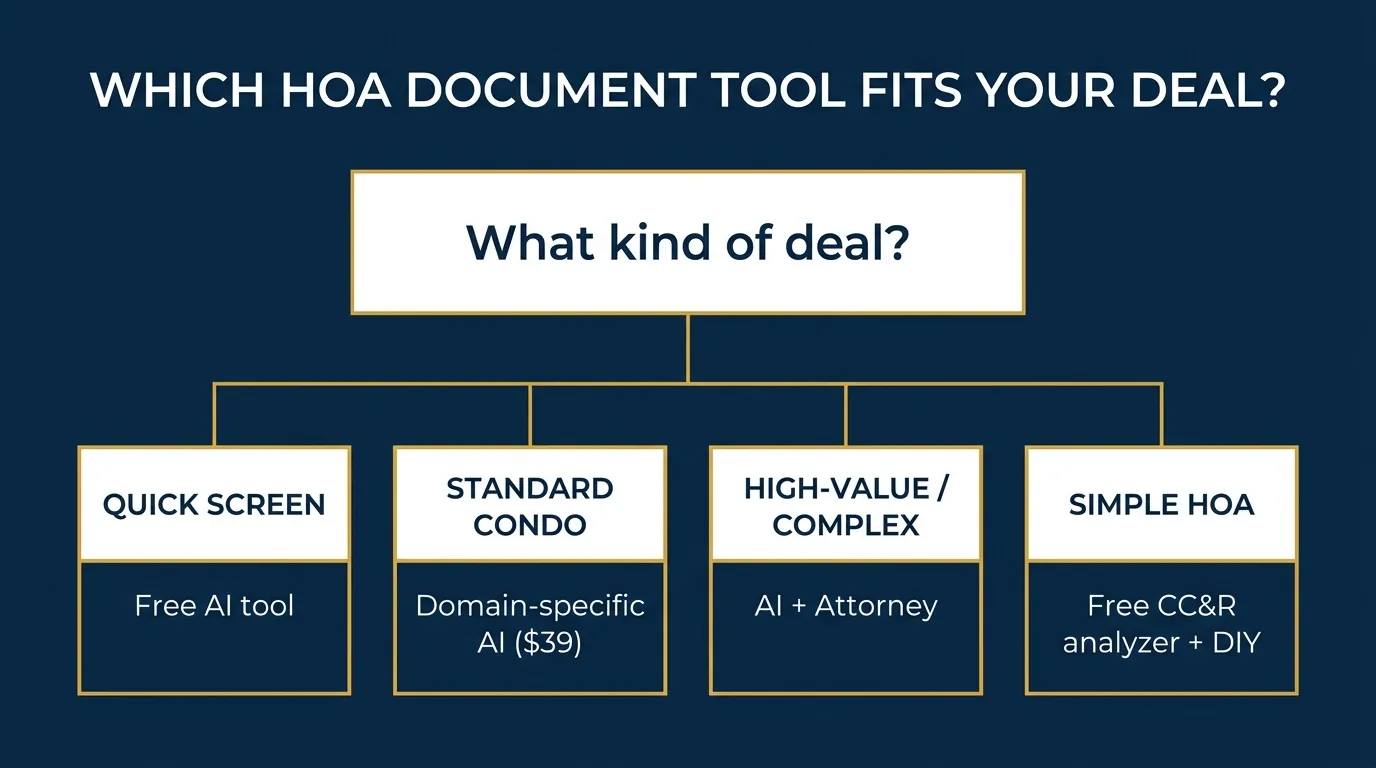
- Quick screen before offer. A free domain-specific tool. Run the seller's CC&R, reserve study, or meeting minutes through a free analyzer in 15 minutes. If anything red-flag-level surfaces, you decide whether the deal is worth deeper review before writing the offer.
- Standard condo purchase under contract. Domain-specific AI for the full packet ($39 range), with the option to escalate one or two questions to an attorney if litigation, easements, or unusual restrictions surface.
- High-value or complex purchase. Domain-specific AI for breadth and pattern detection, plus attorney review for legal opinion and negotiation. The two are complementary. AI catches what a human reading 200 pages in 90 minutes will miss. The attorney advises on consequences.
- Simple, low-value, single-family HOA. DIY with a checklist may be sufficient if the document set is short and boilerplate. Use a free CC&R analyzer as a sanity check.
- Anything where the answer matters and the window is short. Skip ChatGPT. The hallucination rate is too high for a one-shot decision under deadline.
What to Look For in Any HOA Analysis Tool
Five questions separate a useful tool from a glorified summarizer. Run any product you are evaluating through them before you commit.
- Does it analyze every document type, not just CC&Rs? Reserve studies, meeting minutes, financial statements, and audit footnotes carry the most decision-relevant data. A tool limited to CC&Rs misses most of the package.
- Does it cite sources at the page level? Every finding should link back to the page in the source PDF. If you cannot verify the claim against the document, the finding is not actionable.
- Does it flag what is missing from the package? Missing reserve study, missing audit, missing meeting minutes for the last two years. Coverage tracking matters as much as content analysis.
- Does it benchmark against comparable HOAs? "Reserves at 22% funded" means little without "and the industry tier framework calls 0-30% weak." A tool with a real corpus of comparable buildings can give you that context.
- Does it cover your jurisdiction? US-only, US + Canada, single state. Match the tool's coverage to where you are buying.
Frequently Asked Questions
Can I just upload my HOA documents to ChatGPT?
You can, and you will get a fluent-sounding summary. The problem is what is missing: cross-document pattern detection across a multi-PDF packet, benchmarking against comparable buildings, page-level source citations you can verify, and reliable statute references. LLM benchmarks show fabrication rates of 15-20% on general citations and 35-55% on niche or recent ones. For a single-decision purchase under a 3-7 day cancellation window, that is too much risk.
Is GoverningDocs the only AI tool for HOA documents?
No. Eli Report is a credible buyer-facing alternative with 10,000+ reports across the US and Canada and strong coverage in BC strata and Ontario condo. HeyNeighbor targets HOA boards and managers rather than buyers. Rexera serves lenders and title agents. CIDA produces premium-priced human-analyst reports. GoverningDocs is buyer-and-agent-focused with a US emphasis, page-level citations, an A-F health grade, and a $39 flat fee.
When is an attorney worth $500-$2,000?
When active litigation, unusual easements, or material deed restrictions are involved, when the purchase is high-value, or when you need a written opinion that carries professional liability. For a standard condo purchase with a clean packet, attorney review can exceed your cancellation window without surfacing anything a domain-specific tool would not catch first.
How long does manual DIY review of an HOA packet take?
A typical condo resale package runs 200+ pages across CC&Rs, bylaws, reserve study, meeting minutes, and financials. Reading thoroughly with a checklist takes 4-8 uninterrupted hours, plus time to research statute references and benchmark numbers. Most cancellation windows are 3-7 days, so plan accordingly.
Do these tools work for both condos and single-family HOAs?
Most do. Condos add a reserve study, audit, and insurance certificate that single-family HOAs often lack. Single-family HOAs can be lighter on financial documents but heavier on architectural and use restrictions in the CC&Rs. Domain-specific tools are calibrated for both. Generic AI is calibrated for neither.
Get Your HOA Documents Analyzed
GoverningDocs analyzes CC&Rs, reserve studies, and meeting minutes, identifying red flags, restrictions, and financial risks so you can buy with confidence. Free. No signup required.
Your first full property report is also free. See what you'll get →
Or get your first full report free →Related Articles
Sources & References
- Eli Report — Automated condo/strata/HOA document review, 10,000+ reports across US + Canada, free tier with paid options
- HeyNeighbor.AI — AI HOA management platform for boards and managers
- Rexera (formerly InspectHOA) — HOA doc retrieval and condo questionnaires for lenders and title agents
- RealPage acquires Rexera (July 2025)
- CIDA / CID Analytics — Pre-purchase due diligence reports with proprietary score
- Gomez Law: How Much Does an HOA Lawyer Cost — Florida HOA attorney pricing benchmarks
- 2025 LLM hallucination benchmarks — General and niche-topic citation fabrication rates
- StudyFinds: GPT-4o reference fabrication rates
- HomeWiseDocs: Resale package timing and cost — 5-14 day prep, $100-$600 fee ranges
- Association Reserves: Percent-funded tier framework — 0-30% weak, 31-70% fair, 71-130% strong
- HUD FHA Condo Approval rules — 15% delinquency cap
Disclaimer: This article is for educational purposes only and does not constitute legal, financial, or real estate advice. Tool features, pricing, and availability are current as of publication and may change. GoverningDocs is the publisher of this article and is one of the tools compared. Consult a qualified real estate attorney for guidance specific to your situation.