In This Article
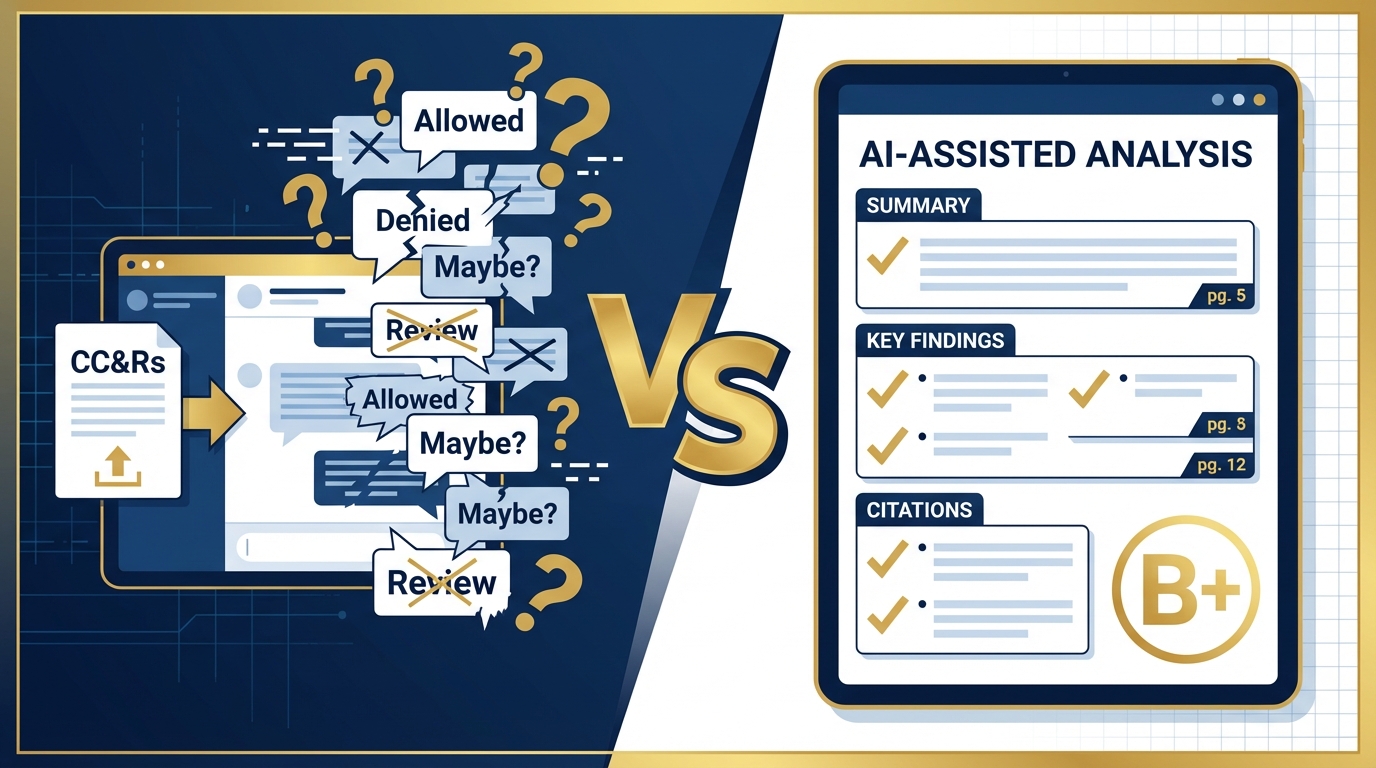
Generic AI chatbots give inconsistent HOA analysis, can't cite source pages, and don't track missing documents. Purpose-built tools solve all three.
Someone on LinkedIn tells you to skip the HOA analysis tool and just upload your CC&Rs to ChatGPT. It sounds reasonable. Why pay for a specialized tool when a free chatbot can read documents?
Here's the problem. Stanford researchers tested GPT-4 on legal questions and found it hallucinated 58% of the time. A Washington State University study found ChatGPT gives different answers 27% of the time when the same question was asked repeatedly. And a Deakin University study found that only 43.8% of ChatGPT's citations are both real and accurate.
For brainstorming? That's fine. For a $500K purchase decision where a missed rental restriction or underfunded reserve can cost you six figures? That's a different conversation entirely.
The "Just Use ChatGPT" Advice Is Everywhere
The advice to skip purpose-built tools and paste documents into ChatGPT is gaining traction on social media. It's partially right and mostly dangerous.
Scroll through real estate LinkedIn or agent forums and you'll see variations of the same post: "Stop paying for AI tools. Just upload your docs to ChatGPT/Claude and ask questions."
The argument has a kernel of truth. Some AI tools really are thin wrappers around the same chatbot APIs, adding a logo and a monthly subscription on top. If that's all a tool does, then yes, skip it.
But "skip the tool, use the chatbot" ignores four fundamental problems that matter when real money is on the line. Problems that the right purpose-built tool actually solves.
Problem #1: Inconsistency
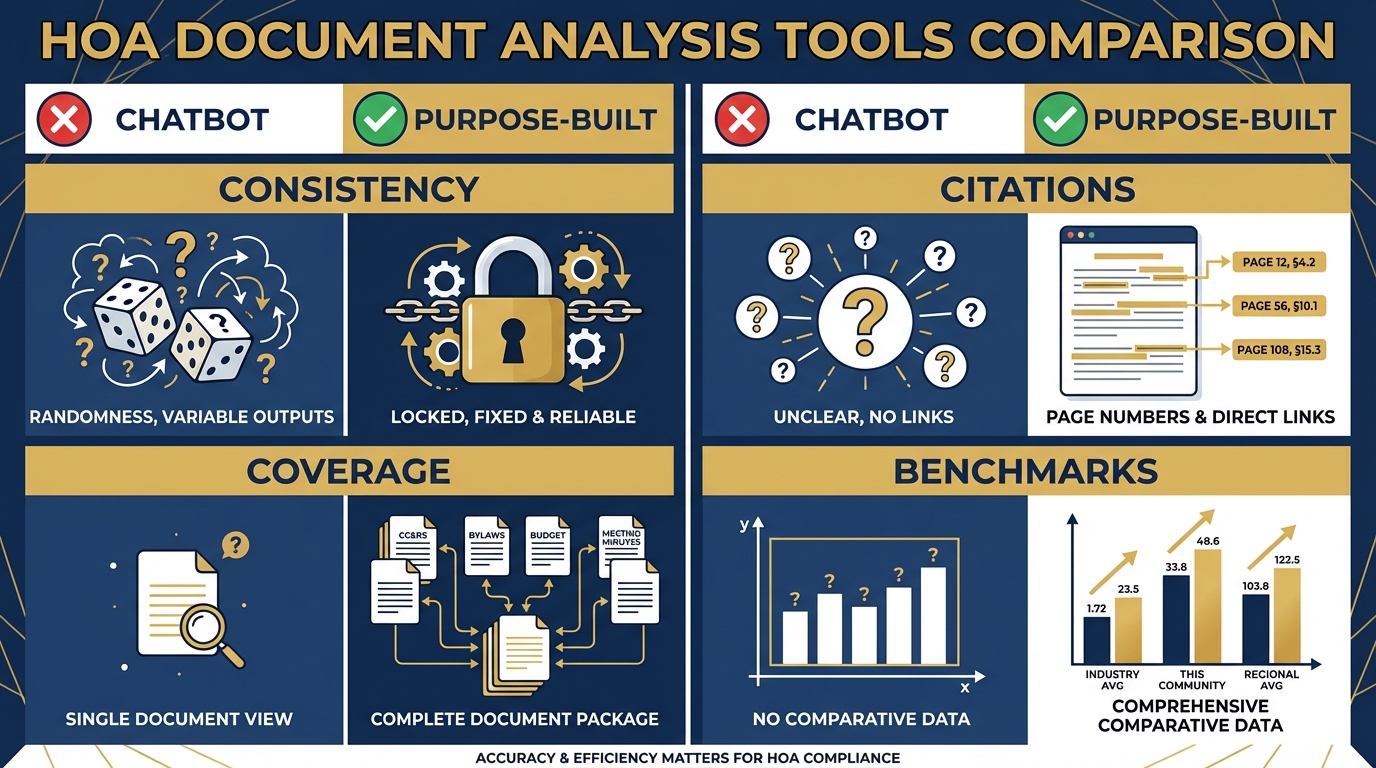
Ask ChatGPT to analyze the same CC&Rs twice and you may get different answers each time. That's not a bug. It's how large language models work.
A March 2026 study from Washington State University submitted the same questions to ChatGPT 10 times each. It gave consistent answers only 73% of the time. More than one in four responses changed on identical input.
This isn't unique to ChatGPT. Even at temperature zero (the most "deterministic" setting), LLMs show up to 15% accuracy variation across runs. OpenAI itself says its API is only "mostly deterministic."
Now apply that to a real scenario. You upload 150 pages of CC&Rs and ask: "Does this building allow short-term rentals?" On Monday, ChatGPT says Section 4.2 prohibits rentals under 30 days. On Wednesday, it says Section 7.8 allows rentals with board approval. Both answers sound authoritative. Which one do you hand to your client?
Purpose-built tools use structured extraction, not free-form generation. They parse the same document the same way every time. The output is deterministic because the process is deterministic.
Problem #2: No Source Linking
ChatGPT can claim "Section 4.2 restricts rentals" but can't show you the page. When the buyer's attorney asks for proof, you're back to reading the document manually.
Deakin University researchers asked GPT-4o to generate academic citations. Only 43.8% were both real and accurate. Nearly 20% were completely fabricated. And when GPT-4o provided DOIs for fake citations, 64% linked to real papers on completely unrelated topics.
If ChatGPT can't reliably cite a published journal article with a DOI, it cannot reliably cite "page 47, Section 4.2" of a CC&R document it was never trained on.
This isn't theoretical. The legal profession has learned this the hard way. In Mata v. Avianca (2023), a New York lawyer used ChatGPT for case research. It fabricated six entirely fictitious cases with fake citations. The lawyer was fined $5,000. Since then, over 1,200 AI hallucination cases have been documented in courts globally, with 128 U.S. lawyers sanctioned.
Real estate transactions demand the same rigor. When you tell a buyer "Section 12.3 on page 89 prohibits Airbnb rentals," that claim needs to link to the actual page. A purpose-built tool provides page-level citations for every finding. ChatGPT gives you prose that sounds right but may point nowhere.
Problem #3: No Coverage Tracking
ChatGPT analyzes what you give it. It won't tell you the reserve study is missing, the financials are three years old, or the insurance certificate is absent.
A typical HOA disclosure package should include CC&Rs, bylaws, financial statements, a reserve study, meeting minutes, and insurance certificates. Most packages are 200 to 400 pages.
But packages are often incomplete. The reserve study might be five years old. The insurance certificate might be missing entirely. The most recent meeting minutes might stop six months ago, right when the board started discussing a major special assessment.
ChatGPT will happily analyze whatever you upload without mentioning what's absent. It doesn't know what a complete package looks like. It can't compare what you have against what you should have.
Knowing what's missing is often more important than what's found. A purpose-built tool trained on thousands of HOA document packages knows exactly which documents should be present and flags gaps automatically. That missing reserve study? It could be hiding a special assessment that ranges from $5,000 to $400,000 per unit in Florida alone.
Problem #4: No Benchmarking
ChatGPT has no context for "is this normal?" It can't tell you whether 45% funded is good or bad, because it has never analyzed 1,900 other HOA documents.
Your CC&Rs say the reserve fund is 45% funded. Is that concerning? ChatGPT might tell you it's "below the recommended level" or "adequate for many associations." Both statements are vague and unhelpful.
A tool trained on 1,900+ HOA documents knows that the industry benchmark for "adequate" is 70% funded or higher. It knows that 45% puts you in the bottom quartile. It can compare your building's reserve contributions against similar buildings in your region.
As Michigan HOA attorney Kevin Hirzel has noted, ChatGPT has no understanding of what your specific governing documents say. It also has no idea what other governing documents say, which means it cannot benchmark yours against anything.
When ChatGPT Is Actually Fine
ChatGPT works well for quick, low-stakes tasks where consistency and citations don't matter.
This isn't an anti-AI argument. ChatGPT and Claude are genuinely useful for certain HOA-related tasks:
- Quick scan of a single short document. Need to understand a two-page amendment in plain English? ChatGPT handles that well.
- Generating questions to ask the HOA board. "What should I ask about this reserve study?" is a great prompt for a chatbot.
- Understanding a specific clause. "Explain what this indemnification provision means" is within ChatGPT's strengths.
- Low-stakes situations. If you're browsing listings and want a rough sense of a building's rules, a chatbot is fine for a first pass.
The line is clear: use chatbots for exploration, use purpose-built tools for decisions. A $500K purchase with a 200-page document package is not an exploration.
A Verdict, Not a Conversation
Agents don't need another conversation with a chatbot. They need a structured report they can hand to a client.
The real difference between a chatbot and a purpose-built tool isn't the underlying AI. It's what the tool is designed to produce.
ChatGPT produces a conversation. You ask, it answers, you follow up, it elaborates. The output is prose. It's ephemeral. There's no structured record to hand to your client or your client's lender.
A purpose-built tool produces a verdict. An A-F health grade. A list of red flags with page-level citations. A coverage map showing which documents were analyzed and which are missing. Financial health metrics benchmarked against comparable buildings.
That's the test for whether an AI tool is worth paying for. Not "can it read my document?" but "does it produce something I can act on and share?"
As legal AI company LegalSifter noted: ChatGPT is "trained to give you the most likely answer, not the right one." For HOA documents, the most likely answer and the right answer are often very different things.
Frequently Asked Questions
Can ChatGPT accurately analyze HOA CC&Rs?
ChatGPT can read and summarize CC&R text, but Stanford research shows GPT-4 hallucinated on 58% of verifiable legal questions. It may flag different sections on different runs, cannot provide page-level citations, and has no way to benchmark findings against other HOA documents. For low-stakes exploration it's useful, but it should not be relied upon for purchase decisions.
What's the difference between ChatGPT and a purpose-built HOA analysis tool?
Purpose-built tools provide deterministic extraction (same document, same results every time), page-level citations for every finding, coverage tracking that flags missing documents, and benchmarking against thousands of analyzed HOA packages. ChatGPT provides conversational responses that may vary between sessions and cannot link claims to source pages.
Is it safe to upload HOA documents to ChatGPT?
There are privacy and legal concerns. In U.S. v. Heppner (February 2026), a federal court ruled that documents a client created using a public consumer AI platform had no attorney-client privilege protection, in part because the platform's privacy policy allowed data collection and sharing. HOA documents containing attorney opinions or privileged communications could be at risk if uploaded to consumer AI tools with similar data practices.
How much does AI HOA document analysis cost compared to an attorney?
Attorney review of HOA documents typically costs $695 or more, with multi-day turnaround. Purpose-built AI tools like GoverningDocs cost $39 per property and deliver results in minutes. Free tools for CC&R analysis and reserve study analysis are also available with no signup required.
Should real estate agents use AI for HOA document review?
Yes, but agents should use purpose-built tools rather than general chatbots for transaction-level analysis. The key requirements are citation grounding (linking every claim to a source page), consistency (same results every time), and coverage tracking (identifying missing documents). General chatbots don't meet these standards for fiduciary-level work.
Get a Structured HOA Analysis, Not a Chat Conversation
Upload your HOA documents for free analysis. Every finding links to the source page. Every report benchmarks against 1,900+ HOA documents. No signup required.
Related Articles
Sources & References
- Stanford "Large Legal Fictions" (GPT-4 hallucination on legal questions; Journal of Legal Analysis, 2024)
- Stanford "Hallucination-Free?" (Legal AI hallucination rates; JELS, 2025)
- Washington State University (ChatGPT consistency study; Rutgers Business Review, March 2026)
- Deakin University (GPT-4o citation accuracy; JMIR Mental Health, November 2025)
- Damien Charlotin AI Hallucination Database (1,227 court cases of AI hallucination globally)
- Harvard Law Review: U.S. v. Heppner (AI-generated documents and attorney-client privilege, February 2026)
- Michigan Condo Law Blog (Kevin Hirzel on ChatGPT and HOA legal advice)
- LegalSifter (Why ChatGPT should not be used for contract review)
Disclaimer: This article is for educational purposes only and does not constitute legal, financial, or real estate advice. AI capabilities and limitations evolve rapidly. Consult a qualified real estate attorney for guidance specific to your situation.