In This Article
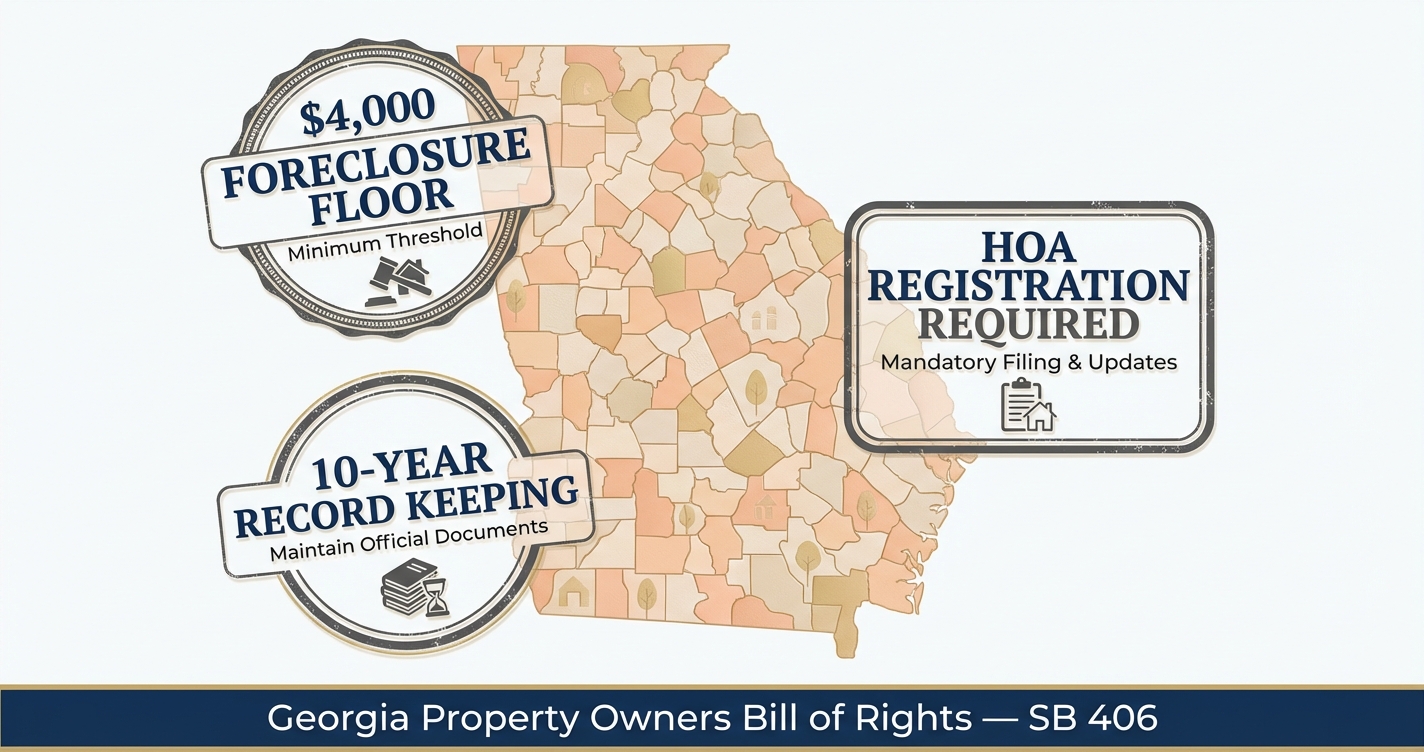
Georgia SB 406 creates mandatory HOA registration, raises the foreclosure threshold to $4,000, requires 10-year record retention, and takes effect January 1, 2027. Buyers should verify HOA compliance status before closing.
Tricia Quigley lived in her Cherokee County home for 18 years. Then her HOA sold it on the courthouse steps for $3.24.
Her offense? Missing two biannual dues payments totaling $800. The HOA purchased the home for $3.24, then continued accepting her dues payments (over $4,600 total) on a property she apparently no longer owned. She spent more than $10,000 trying to fix the situation before being evicted from her own home.
This happened because Georgia had zero HOA oversight. No registration. No foreclosure minimums. No complaint process. An HOA could foreclose over a few hundred dollars and nobody at the state level could intervene.
On March 31, 2026, the Georgia House passed SB 406 by a vote of 155-10. The Senate had already passed it 53-0. Known as the Georgia Property Owners' Bill of Rights Act, it creates the first state-level HOA oversight framework in Georgia's history. The bill now awaits Governor Kemp's signature.
What SB 406 Requires
Every Georgia HOA must register with the state, retain records for 10 years, and provide a 90-day cure period before any foreclosure.
The bill covers six major areas. Here are the provisions that matter most for buyers:
Mandatory registration. Under the bill's provisions, every HOA must register annually with the Georgia Secretary of State. Registration requires submitting governing documents plus three years of financial records. If an HOA fails to register, it cannot collect fines, record liens, or initiate foreclosures. The Secretary of State can deny, suspend, or revoke registrations.
Foreclosure protections. The threshold for HOA foreclosure rises from $2,000 to $4,000 in unpaid dues (or 12 months of regular assessments, whichever is less, with a $2,000 minimum). Fines and fees are excluded from the threshold calculation. HOAs must provide a 90-day cure period before filing to foreclose. Under SB 406, Tricia Quigley's $800 balance would have been well below the minimum threshold.
Financial transparency. HOAs must retain records for 10 years. Payments from homeowners must go toward regular dues first, then special assessments, then fines.
Complaint process. Homeowners can file complaints directly with the Secretary of State. A hearing officer process (not court) handles disputes. Collection of fines and fees is automatically stayed during the complaint process.
Attorney fee restrictions. Effective July 1, 2026 (ahead of the rest of the bill), HOAs must provide specific written notice and a 30-day payment window before attorney fees can accrue. Itemized fee lists are required, and a judge must determine reasonableness before fees are awarded.
Why It Matters for Condo Buyers
11,200 Georgia HOAs covering 2.3 million residents now face mandatory state registration and financial transparency requirements.
Georgia has approximately 11,200 HOA communities covering about 874,000 homes and 2.3 million residents, according to the Community Associations Institute. Until now, none of these communities operated under any state-level oversight.
For buyers, the impact is straightforward. Starting January 1, 2027, any Georgia HOA that hasn't registered with the Secretary of State loses its enforcement powers. That means a buyer can check whether the HOA they're buying into is compliant. An unregistered HOA is a red flag. A registered one with three years of financials on file gives you a baseline to evaluate.
The foreclosure protections also change the risk calculation. Before SB 406, buyers in Georgia HOA communities faced the possibility of losing their home over small unpaid balances. Juliet Graham told Georgia lawmakers her final HOA bill reached $250,000. James McAdoo owed $36,000 over yard weeds and had $600 garnished from every paycheck until he filed bankruptcy. Karyn Gibbons mailed her dues checks monthly, but her HOA took months to cash them and then hit her with $34,000 in late fees, interest, and attorney fees.
SB 406 doesn't eliminate all risk. But it creates a floor of accountability that didn't exist before.
What Buyers Should Do Now
Don't wait for January 2027. Review HOA documents before closing. Check registration status, financials, and fine structures now.
The law doesn't take full effect until January 1, 2027. If you're closing on a Georgia HOA property before then, the old rules still apply. That makes reviewing HOA documents before closing even more important right now.
Here's what to check:
- CC&Rs and bylaws. Look at the fine structure, foreclosure provisions, and payment hierarchies. SB 406 reforms all of these areas. If the current documents have aggressive provisions, check whether the HOA is preparing to update them for compliance. A free CC&R analysis tool can help you pull out the key sections.
- Financial records. Request at least three years of financials. That's what the HOA will need to submit for registration anyway. If they can't produce them now, that's a red flag.
- Meeting minutes. Board meeting minutes will show whether the HOA has discussed SB 406 compliance. If there's no mention of registration planning or document preparation, that tells you something.
- Registration status (after Jan 1, 2027). Once the law takes effect, check whether the HOA is registered with the Secretary of State. An unregistered HOA cannot enforce fines or foreclose. That's either very good or very bad depending on the situation.
Will Other States Follow?
Florida and Colorado already regulate HOAs. Georgia's near-unanimous bipartisan vote signals a national trend toward HOA accountability.
Georgia isn't the first state to regulate HOAs, but the scope of SB 406 is notable. The near-unanimous votes (53-0 in the Senate, 155-10 in the House) signal bipartisan agreement that HOA oversight is overdue.
Florida passed SB 4-D in 2022, requiring structural inspections and reserve funding for condominiums after the Surfside collapse. Colorado has strengthened HOA transparency requirements in recent years. Several other states are considering similar legislation.
The pattern is consistent. State legislatures are responding to homeowner complaints about unchecked HOA power. Buyers in any state should be reviewing HOA documents carefully regardless of whether their state has passed oversight legislation yet.
Frequently Asked Questions
When does Georgia SB 406 take effect?
Most provisions take effect January 1, 2027. Attorney fee restrictions take effect earlier, on July 1, 2026. The bill passed the House 155-10 on March 31, 2026 and awaits Governor Kemp's signature.
What happens if a Georgia HOA doesn't register under SB 406?
An unregistered HOA loses key enforcement powers. It cannot collect fines, record liens, or initiate foreclosures. The Secretary of State also gains authority to deny, suspend, or revoke registrations for non-compliant HOAs.
Can a Georgia HOA still foreclose over small amounts after SB 406?
SB 406 raises the foreclosure threshold from $2,000 to $4,000 in unpaid regular assessments (or 12 months of assessments, whichever is less, with a $2,000 minimum). Fines and fees cannot be included in the threshold calculation. A mandatory 90-day cure period must be provided before the HOA can file to foreclose.
Buying Into a Georgia HOA? Check the Documents First.
Upload your CC&Rs or meeting minutes for free analysis. Every finding links to the source page. No signup required.
Related Articles
Sources & References
- Atlanta News First (Georgia House passes HOA oversight bill, March 31, 2026)
- Georgia Legislature (SB 406 bill text, 2025-2026 session)
- WSB-TV Channel 2 (Homeowner testimony: Graham, McAdoo, Gibbons cases)
- CAI Foundation for Community Association Research (Georgia HOA statistics: 11,200 associations, 2.3M residents)
Disclaimer: This article is for educational purposes only and does not constitute legal, financial, or real estate advice. Georgia SB 406 awaits the Governor's signature as of publication. Provisions may change. Consult a qualified real estate attorney for guidance specific to your situation.