In This Guide
A SIRS report assesses 8 structural components and their funding needs. Check percent funded, RUL=0 items, and whether mandatory reserves are in the budget.
A Florida condo listing shows a great price, low HOA fees, and ocean views. What it doesn't show is the building's SIRS report, which reveals $2.8 million in structural repairs that need funding over the next five years.
Since January 1, 2026, Florida condos can no longer waive funding for structural reserves. That means buildings that deferred maintenance for decades now have to start paying for it. Owners in non-compliant buildings are getting hit with special assessments that can range from tens of thousands to over $100,000 per unit depending on building size and level of deferred maintenance. If you buy into the wrong building, you inherit that bill.
The SIRS report is the document that tells you exactly where a building stands. It covers the 8 structural components Florida law now requires condos to fund, and it shows whether the association is keeping up or falling behind. This guide explains what a SIRS report is, how to read one, and what red flags to look for before you buy.
Check Your Building's Financial Health
Upload your HOA's reserve study and get instant analysis of percent funded, deferred maintenance, and special assessment risk. Free. No signup required.
What Is a SIRS (Structural Integrity Reserve Study)?
A SIRS is a Florida-mandated study of 8 structural components and the reserves needed to maintain them.
SIRS stands for Structural Integrity Reserve Study. It was created by Florida law (SB 4D, 2022) after the Champlain Towers South collapse in Surfside (June 2021, 98 deaths), which exposed how Florida condos had been deferring critical structural maintenance for years.
Unlike a traditional reserve study that covers everything from pool resurfacing to parking lot paving, a SIRS focuses exclusively on structural and safety-critical components. Think roofs, load-bearing walls, plumbing, and fire protection systems.
SIRS reports are required for condos and co-ops that are 3 or more habitable stories. Single-family HOAs, townhome communities, and low-rise buildings under 3 stories are generally exempt.
The 8 Mandatory SIRS Components
Florida law requires SIRS funding for roof, structure, fire protection, plumbing, electrical, waterproofing, windows, and other items over $25,000.
Florida Statute §718.112(2)(g) specifies exactly which building components must be included in a SIRS. There are no exceptions or substitutions:
- Roof: All roof types including flat, tile, metal, and shingle
- Structure: Load-bearing walls, columns, foundations, and beams
- Fireproofing and fire protection systems:Sprinklers, fire alarms, fireproofing materials
- Plumbing: Supply lines, waste lines, risers, main shutoffs
- Electrical systems: Main distribution panels, wiring, transformers
- Waterproofing and exterior painting: Sealants, coatings, stucco, caulking
- Windows and exterior doors: Common area only (not individual unit windows unless association-maintained)
- Any other item costing more than $25,000 that affects structural integrity : Seawalls, parking garages, balcony railings, elevator shafts
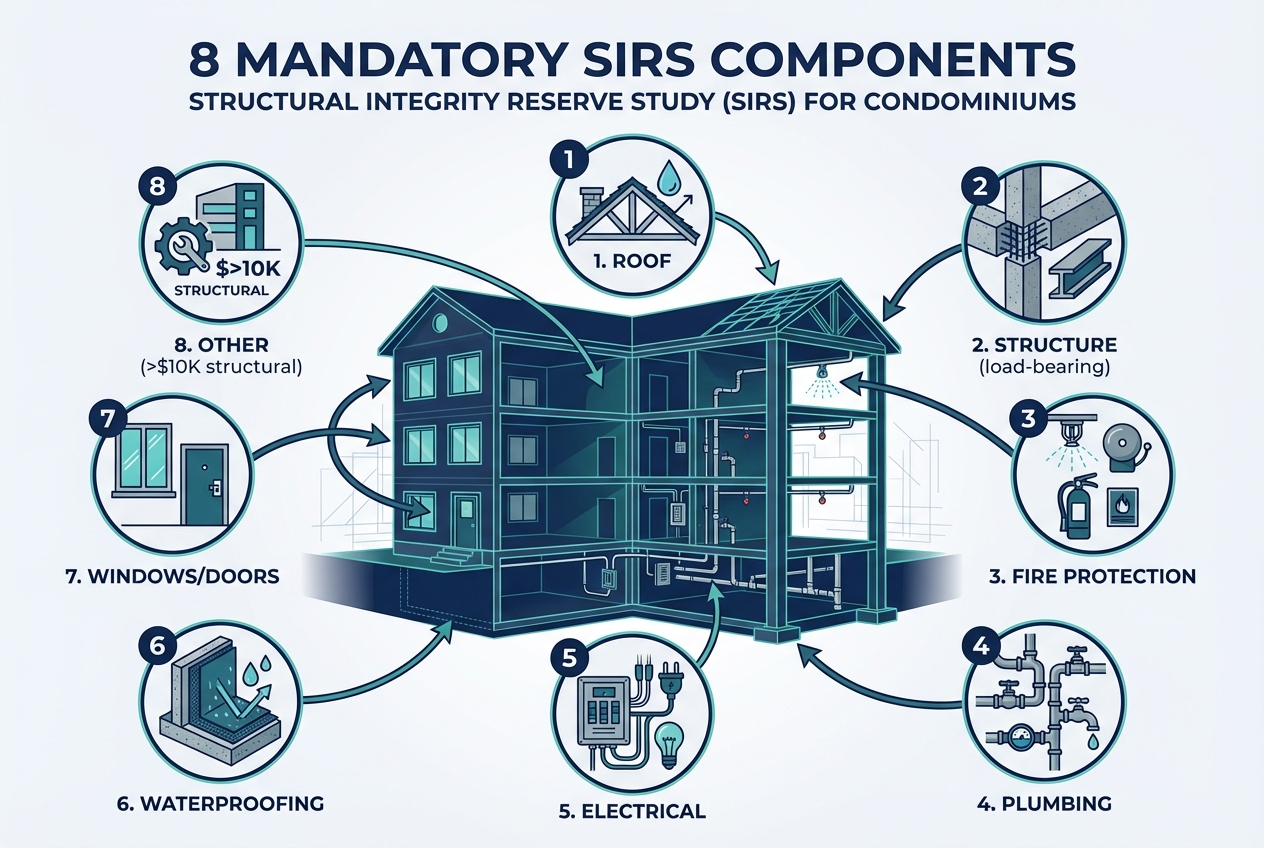
The 8 components Florida law requires condos to assess and fund
Component #8 is the catch-all that trips up many buildings. A deteriorating seawall or a parking garage with crumbling concrete can cost millions, and if it affects structural integrity, it must be in the SIRS.
Key SIRS Deadlines (2025-2026)
SIRS completion was due December 31, 2025. Mandatory reserve funding started January 1, 2026.
December 31, 2025
Deadline for eligible buildings to complete their first SIRS
January 1, 2026: NOW IN EFFECT
Reserve funding for SIRS components is mandatory. Associations can no longer waive or reduce these reserves by owner vote.
Every 10 years
SIRS must be updated. Milestone inspections also required for buildings 3+ stories that are 30+ years old (25 years if within 3 miles of the coast).
Important: A significant number of eligible Florida condos have not completed their SIRS as of early 2026, with industry estimates suggesting more than half are non-compliant. If a building missed the deadline, that's a red flag. Non-compliance can mean penalties, financing restrictions, and accelerated assessment timelines.
SIRS vs Traditional Reserve Study: What's the Difference?
A SIRS covers only structural components and can't be waived. A traditional reserve study covers everything and can be waived by vote.
This is one of the most common points of confusion. A SIRS is not the same as a traditional reserve study. Many buildings have a reserve study but no SIRS, which means they may not be compliant.
| Aspect | SIRS | Traditional Reserve Study |
|---|---|---|
| Focus | Structural/safety components only | All common area components |
| Components | 8 mandatory | 50-100+ (pools, HVAC, landscaping, etc.) |
| Can owners waive funding? | NO (after Jan 2026) | Yes (with majority vote) |
| Required? | Yes (FL condos 3+ stories) | Recommended, not mandated |
| Who prepares it? | Licensed PE or Architect (visual inspection); Reserve Specialist may assist with financial analysis | Reserve specialist or engineer |
| Update frequency | Every 10 years | Every 3-5 years (recommended) |
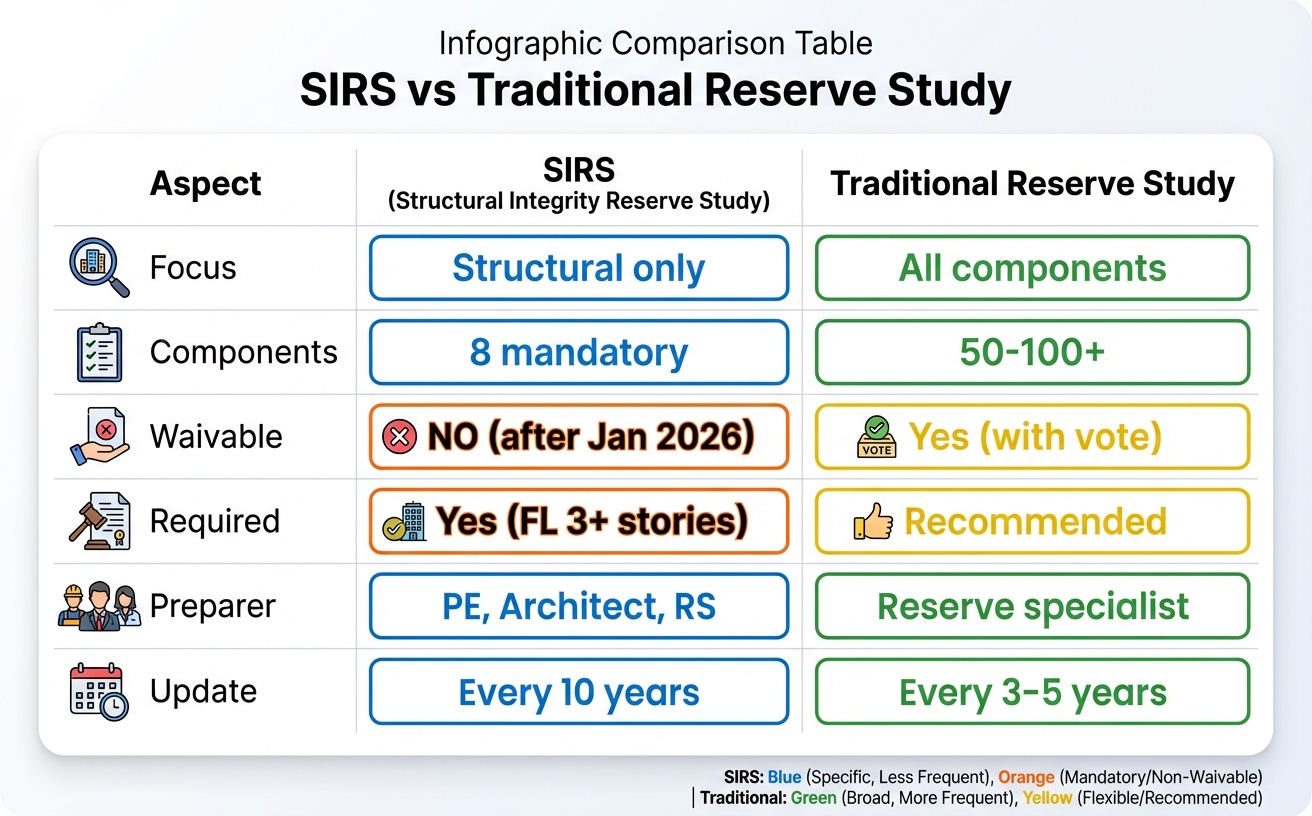
Key differences between a SIRS and a traditional reserve study
The critical difference: SIRS reserves cannot be waived. Before 2026, Florida condo owners could vote to waive or reduce reserve contributions. Many did, kicking the can down the road for decades. That option is gone for the 8 SIRS components.
How to Read a SIRS Report in 5 Minutes
Find percent funded, RUL=0 items, total SIRS requirement, and the gap between current and recommended contributions.
SIRS reports can run 30-80 pages. You don't need to read every page. Focus on these five numbers:
1. Percent Funded
This is the single most important number. It tells you how much money the association has saved compared to how much it should have. These thresholds are industry guidelines (not statutory requirements), but they're widely used by reserve professionals:
- Above 70%: Generally considered healthy.
- 50-70%: Moderate risk. Fees may increase.
- 30-50%: Higher risk. Special assessments more likely.
- Below 30%: Critical. Significant assessment risk.
2. Items at RUL=0 (Remaining Useful Life = Zero)
RUL=0 means a component has reached the end of its expected lifespan and needs replacement now. Multiple items at RUL=0 means deferred maintenance is piling up. Each one represents a repair bill that hasn't been paid yet.
3. Total SIRS Reserve Requirement
This is how much the association needs in its SIRS reserve fund total. Compare it to what they actually have. The gap between those two numbers is your exposure.
4. Current vs Recommended Annual Contribution
If the building is currently contributing $200,000 per year to SIRS reserves but the study recommends $450,000, those HOA fees are going up. That gap tells you how much more you'll be paying.
5. SIRS vs Non-SIRS Funding Split
Some reserve studies combine SIRS and non-SIRS components. Make sure you're looking at SIRS-specific funding. Non-SIRS reserves (pool, landscaping, etc.) can still be waived by owner vote. SIRS reserves cannot.
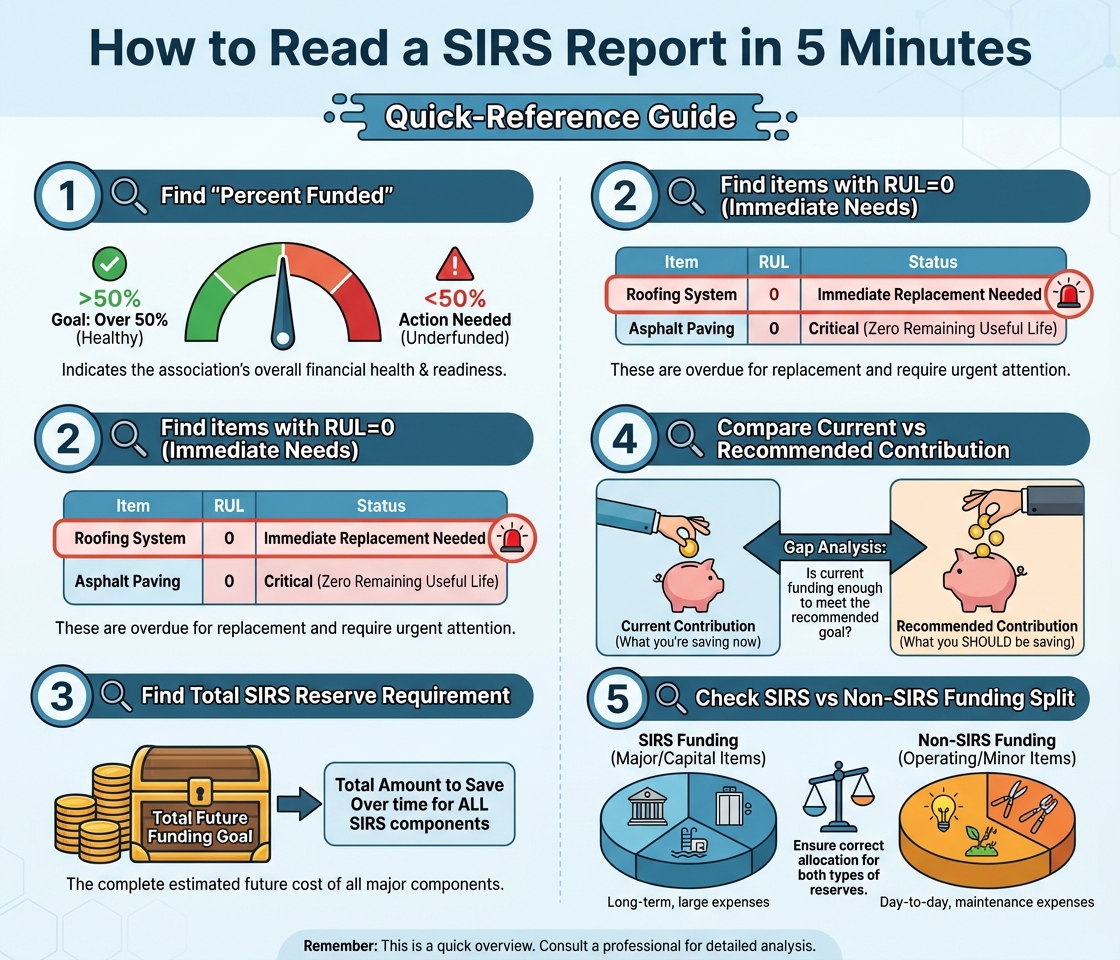
The 5 key numbers to find in any SIRS report
What Engineers Actually See: Condition Ratings in Context
SIRS reports assign condition ratings (Good, Fair, Poor) to each component. But what do those ratings actually mean in practice? According to structural engineer Evan Swaysland, PE, president of Swaysland Professional Engineering Consultants and an expert in concrete repair with American Concrete Institute and Post-Tensioning Institute certifications:
"Most of the time, most of the buildings we look at are Fair with some areas of Poor elements. There's nothing that has ever been Good or Exceptional. Most everything needs some level of work done in some capacity."
What this means for buyers: A "Fair" rating on a Florida coastal building 25+ years old is typical, not reassuring. The real question is whether the association is actively addressing the work that needs to be done, or deferring it. Look at the contribution gap and board meeting minutes for that answer.
Related: How to Read a Reserve Study in 5 Minutes →
Red Flags in SIRS Reports
Watch for multiple RUL=0 items, concrete restoration needs, fire system gaps, and large contribution shortfalls.
Not every building with low reserves is a disaster. But certain combinations of findings should make you pause:
SIRS Red Flags to Watch For
- ✕Multiple items at RUL=0: One expired component is normal. Three or four means the board has been deferring maintenance across the board.
- ✕Concrete restoration needed: One of the most expensive SIRS items. Spalling concrete, rebar corrosion, and balcony repairs can run $5-15 million for a mid-size building.
- ✕Fire protection system deficiencies: Carries safety and insurance implications. Outdated fire suppression may mean higher premiums or coverage denials.
- ✕Percent funded below 30%: The association almost certainly needs a special assessment. Buildings this underfunded often face significant per-unit assessments.
- ✕Large contribution gap: If current funding is half or less of the recommended amount, fees are going up significantly or an assessment is coming.
- ✕Cantilevered balcony repairs noted:Cantilevered balcony slab repairs are among the most disruptive SIRS items. They often require access through interior units, temporary walls, flooring removal, and can affect multiple floors simultaneously. One structural engineer describes explaining to owners: "I have to remove your door. I have to put in a temporary wall... your neighbor's affected, you're affected, and underneath's affected."
- ✕Post-tensioned concrete issues: Buildings with post-tensioned concrete slabs face unique risks. If slabs were not properly stressed during original construction, multiple floors may need emergency shoring. These repairs are urgent and expensive.
- ✕No SIRS report available: The building is non-compliant. This affects financing eligibility and signals governance problems.
Green flag: Protective coatings on balcony slabs
Engineers prefer buildings that use protective coatings or stamped concrete on balcony slabs instead of decorative tile. Tile hides structural damage and interferes with inspection techniques like ground-penetrating radar (GPR). A building that has removed tile and applied protective coatings is signaling proactive maintenance. As one structural engineer puts it: "Tile hides damage. We want to see it."
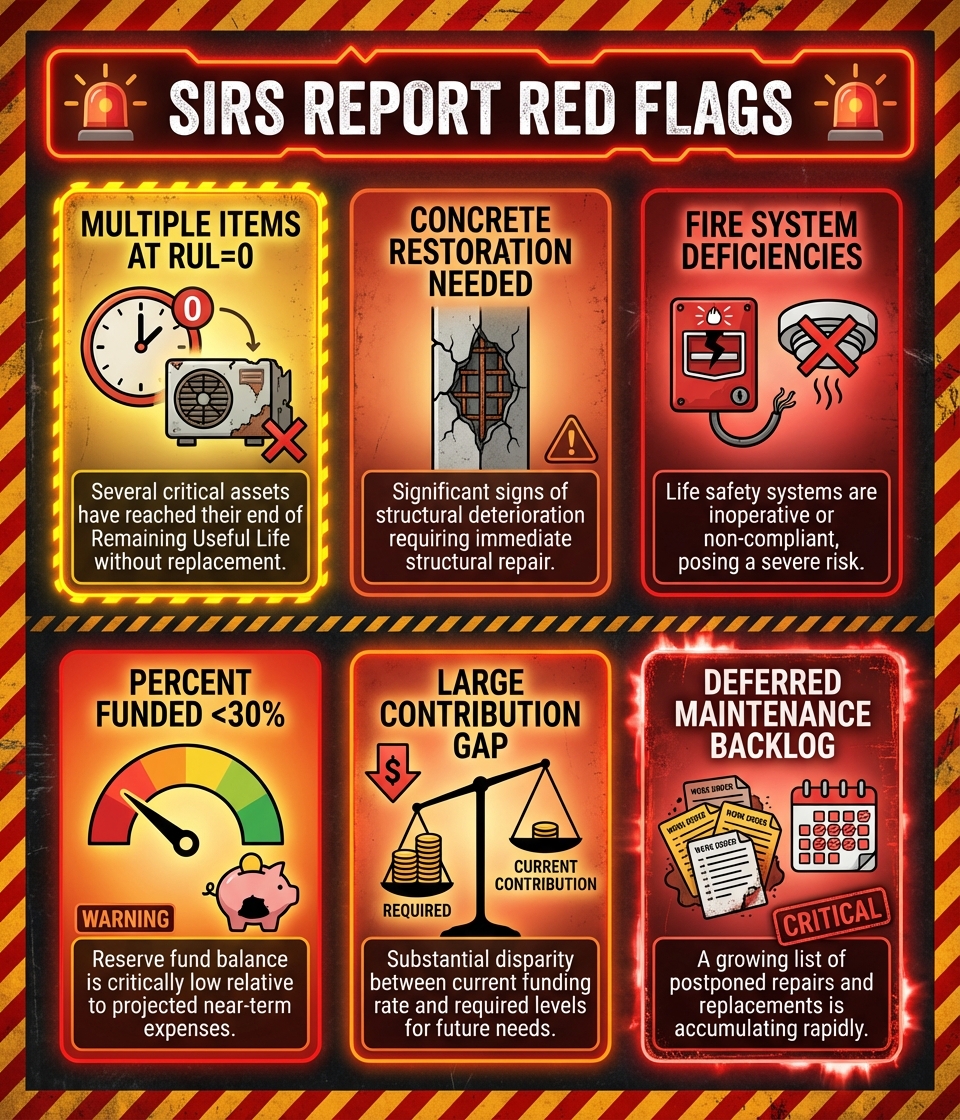
Red flags that indicate potential special assessments ahead
What SIRS Reports Tell Buyers
SIRS reports answer four buyer questions: assessment risk, structural safety, financing eligibility, and repair responsibility.
Will I Face a Special Assessment?
Check percent funded and contribution gaps. A building at 25% funded with a $3 million shortfall is going to assess owners. It's not a question of if, but when and how much.
Is This Building Structurally Safe?
The SIRS covers structural components specifically. RUL=0 items on load-bearing elements or fire protection systems are safety concerns, not just financial ones. Cross-reference with the Milestone Inspection report if the building is 30+ years old (25 years if within 3 miles of the coast).
Can I Get Financing?
Fannie Mae and Freddie Mac now look at SIRS compliance when evaluating condo loans. More than 1,400 Florida condo buildings are on Fannie Mae's restricted list. A non-compliant building may be classified as "non-warrantable", meaning conventional mortgages are unavailable. You'd need a portfolio lender or cash.
Who Pays for Structural Repairs?
The SIRS tells you what needs fixing. Your CC&Rs tell you who pays. Some buildings assign certain components (like unit balconies) to individual owners. Others cover everything from the association reserve. Check both documents together.
Connect the SIRS to Other Documents
- SIRS + CC&Rs: Who is responsible for each component?
- SIRS + Budget: Is the recommended contribution actually in the budget?
- SIRS + Meeting Minutes: Has the board discussed deferred items or assessment plans?
- SIRS + Insurance: Are structural repairs covered or excluded?
Budget for cost growth
The repair costs listed in a SIRS are estimates. When contractors actually begin excavating concrete or opening up walls, they almost always find additional damage. As structural engineer Evan Swaysland, PE explains: "That initial inspection is not going to be a hundred percent of the work we find. There is an uncovering process to all of this. These projects evolve." Repair scopes primarily grow, not shrink, once work begins. Factor in this cost growth when evaluating a building's true financial exposure.
Ask about peer reviews
Some associations commission a second engineering firm to peer review the original SIRS inspection. A legitimate peer review should be more robust, not less. Be cautious if a building replaced a comprehensive report with one that finds fewer problems. Building officials may accept the most recent submission, so the quality of the reviewing engineer matters. Check whether the original report and any peer review are both available for comparison.
Related: How to Review HOA Documents Before Buying →
See Sample ReportHow to Get a Building's SIRS Report
Request from the property manager, check the resale disclosure package, or search the state database.
There are three ways to get a SIRS report as a buyer:
Request from the association or property manager. Under Florida's updated disclosure requirements (HB 913), buyers now have a 7-day review period for condo documents, up from 3 days. The SIRS should be included in the resale disclosure package.
Check the state database. The Florida DBPR (Department of Business and Professional Regulation) maintains condo records at MyFloridaLicense.com. Not all SIRS are uploaded, but it's worth checking.
Ask your agent. A good buyer's agent in Florida should be requesting SIRS compliance status as part of the offer process. If your agent doesn't know what a SIRS is, that's a red flag on its own.
If the building can't produce a SIRS report: That means they either haven't completed one (non-compliant) or are unwilling to share it. Either way, proceed with extreme caution.
Milestone Inspection vs SIRS: How They Work Together
The milestone inspection tells you what needs fixing. The SIRS tells you how to fund it. They're different reports with different purposes.
Many buyers (and some boards) confuse these two requirements. Here's how they connect:
Phase 1: Visual Inspection
A licensed engineer visually inspects the building's structural components. Top firms now go into every unit (100% coverage), not just a 10-25% sample. If no structural deterioration is found, the building passes. This is rare for coastal buildings over 25 years old.
Phase 2: Detailed Investigation (if Phase 1 finds issues)
If Phase 1 finds any repair need, the building moves to Phase 2. This involves more invasive testing to determine the full scope of damage, followed by engineered plans and specifications for repair. A thorough Phase 1 reduces Phase 2 scope and cost.
SIRS: The Funding Plan
The SIRS is a separate financial document that incorporates the engineer's findings and calculates how much the association needs to reserve for repairs and replacements over time. Reserve companies use the engineering reports to estimate service life and funding requirements.
Why this matters for buyers: Ask whether the building has completed both the milestone inspection and the SIRS. A building with a SIRS but no milestone inspection may be basing its financial projections on incomplete information. A building that passed Phase 1 cleanly is in stronger structural shape than one currently in Phase 2 repairs.
5 Questions to Ask About a Building's Structural Health
Reading a SIRS report tells you where a building stands. These five questions, drawn from structural engineers who inspect Florida condos daily, tell you what the report alone won't.
"Has the building completed both its Milestone Inspection and SIRS?"
These are different reports. The milestone inspection is the structural assessment; the SIRS is the financial plan. A building needs both to be fully compliant. If only one exists, ask why.
"What condition ratings did the engineer assign to structural components?"
Remember that "Fair" is the norm for most Florida buildings 25+ years old. "Good" or "Exceptional" is essentially nonexistent. Focus on which specific components are rated "Poor" and what the remediation timeline looks like.
"Did the engineer inspect every unit, or just a sample?"
Post-Surfside, leading engineering firms inspect 100% of units rather than the traditional 10-25% sample. Full coverage means fewer surprises during repairs and a more accurate SIRS funding estimate. If only a sample was inspected, the true scope of repairs may be larger.
"Does the association maintain records of past repairs and inspections?"
Engineers say documentation is the first sign of a well-maintained building. An association that can produce past inspection reports, repair scopes, and contractor records is a better bet than one that can't locate its own files.
"What is the engineering firm's track record with this type of building?"
Look for firms with longevity in the Florida market and specific experience in concrete restoration, not general engineering. Ask for current project references rather than testimonials. Post-Surfside, many new firms entered the market. Community ties and specialized expertise matter.
Bottom Line: Read the SIRS Before You Buy
A SIRS report is not optional reading for Florida condo buyers. It's the document that separates a building keeping up with structural maintenance from one headed toward a six-figure assessment.
Before making an offer on a Florida condo:
Check Your Building's Financial Health
Upload your HOA's reserve study and get instant analysis of percent funded, deferred maintenance, and special assessment risk. Free. No signup required.
Frequently Asked Questions
What does SIRS stand for?
SIRS stands for Structural Integrity Reserve Study. It's a Florida-specific reserve study focused on 8 structural and safety-critical building components that associations must fund.
Which Florida condos need a SIRS?
Condominiums and cooperative associations with buildings that are 3 or more habitable stories are required to complete a SIRS. Single-family HOAs and low-rise buildings under 3 stories are generally exempt.
Is a SIRS the same as a reserve study?
No. A SIRS covers only 8 structural components and cannot be waived. A traditional reserve study covers all common area components (50-100+) and can be waived by owner vote. A building can have a reserve study but still be non-compliant if it hasn't completed a SIRS.
Can Florida condo owners still waive reserves?
Only for non-SIRS components. As of January 1, 2026, funding for the 8 SIRS structural components is mandatory and cannot be waived or reduced by owner vote. Non-SIRS reserves (pools, HVAC, landscaping) can still be waived with a majority vote.
What happens if a building hasn't completed its SIRS?
Non-compliant buildings face potential penalties, may be classified as "non-warrantable" by lenders (blocking conventional mortgages), and could face accelerated assessment timelines when they do comply. Buyers should treat non-compliance as a significant red flag.
How much do SIRS-related special assessments cost?
Assessments vary widely by building size, age, and level of deferred maintenance. Buildings with very low SIRS funding (below 30%) often face significant per-unit assessments. Buildings with severe structural issues (concrete restoration, roof replacement) have seen assessments exceeding $100,000 per unit in some reported cases.
What is the difference between a milestone inspection and a SIRS?
A milestone inspection is a structural assessment performed by a licensed engineer to identify deterioration (Phase 1: visual inspection, Phase 2: detailed investigation if issues found). The SIRS is a separate financial document that calculates reserve funding requirements based on the engineering findings. The milestone tells you what needs fixing; the SIRS tells you how to fund it. A building needs both.
Who prepares a SIRS report?
The visual inspection portion of a SIRS must be performed by a licensed Professional Engineer (PE) or licensed Architect. The financial analysis and funding plan can be prepared by a credentialed Reserve Specialist (RS) or Professional Reserve Analyst (PRA) working in conjunction with the licensed professional. The preparer must be independent with no conflict of interest with the association.
Sources & References
- Surfside condominium collapse - Wikipedia (98 deaths confirmed)
- Florida Senate Bill 4-D (2022) - Florida Senate, enrolled bill text (original SIRS mandate)
- Florida House Bill 913 (2025) - Florida House of Representatives (extended deadlines, 7-day review, $25K threshold)
- Florida Statute §718.112 - Florida Legislature (SIRS component requirements)
- DBPR Condominium FAQs - Florida Department of Business & Professional Regulation
- 62% of South Florida condo associations failed SIRS deadline - Condo Vultures, citing Miami Association of Realtors (Feb 2025)
- New 2025 Florida Condo Laws (HB 913) - Perez Mayoral, P.A.
- Take It to the Board Podcast: Structural Inspections with Evan Swaysland, PE - Attorney Donna DiMaggio Berger interviews Evan Swaysland, President of Swaysland Professional Engineering Consultants (Cooperator Expo live episode, 2025)
- Fannie Mae restricted condo list - Redfin (1,400+ Florida buildings restricted)
This article is for informational purposes only and does not constitute legal, financial, or professional advice. Florida condo law is complex and subject to change. Consult a licensed attorney or qualified professional for guidance specific to your situation.