In This Post
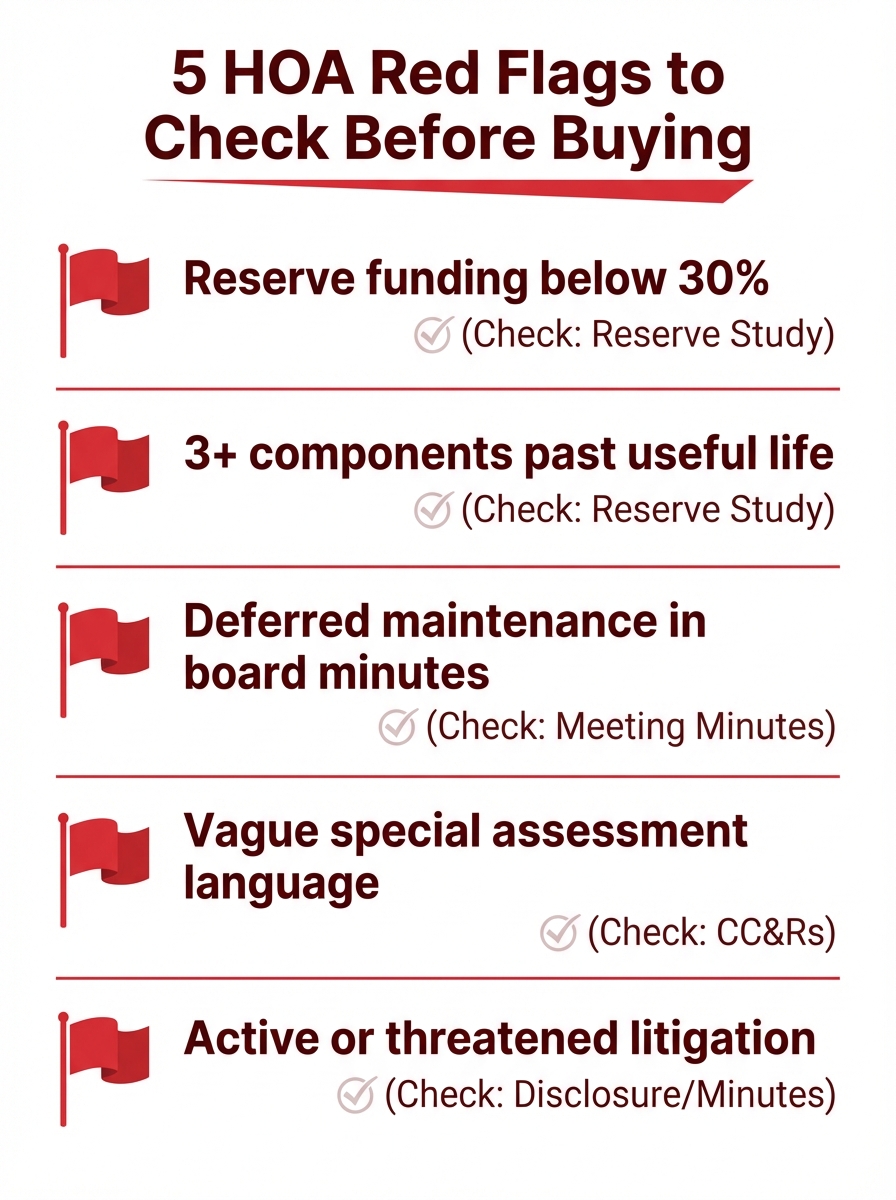
After analyzing 1,900+ HOA documents, the five most reliable predictors of special assessments are: reserve funding below 30%, components past their useful life, repeated deferred maintenance in board minutes, vague assessment language in CC&Rs, and active litigation.
Most buyers flip through 300+ pages of HOA documents during their review period and have no idea what they're looking at. The CC&Rs read like a contract written for lawyers. The reserve study is 80 pages of spreadsheets. The board minutes are full of acronyms nobody explains.
So buyers skim, sign, and hope for the best. Then six months later, a $25,000 special assessment shows up in the mail. The roof that "looked fine" during the walkthrough has been on the replacement list for three years. The board has been talking about it in meeting minutes the buyer never read.
We built GoverningDocs to solve this problem. After processing over 1,900 HOA document packages, we started seeing the same warning signs appear over and over. Not dozens of them. Five. The same five patterns that show up in documents months or years before a special assessment lands.
Based on GoverningDocs Research
This post draws on our analysis of 1,900+ HOA document packages including CC&Rs, reserve studies, board meeting minutes, budgets, and financial statements from associations across the United States.
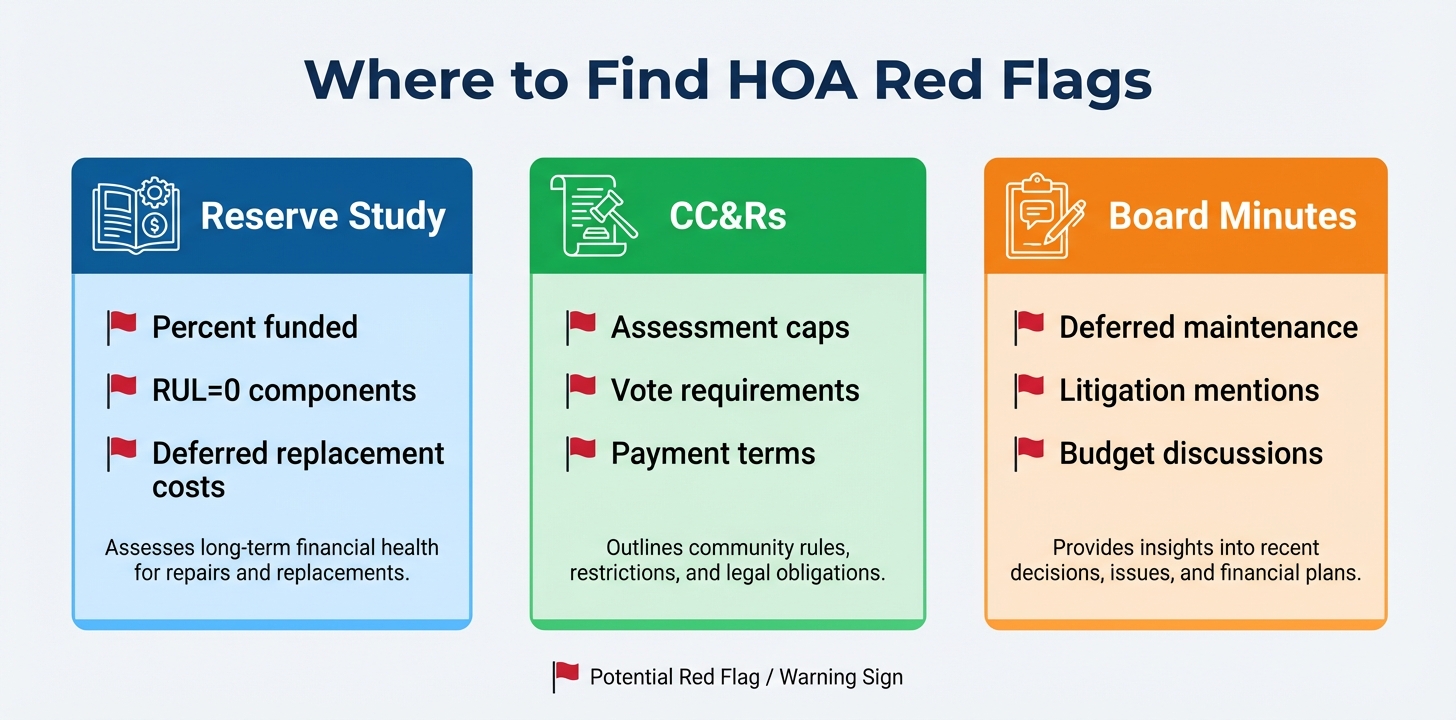
Each red flag lives in a specific document. Knowing where to look saves hours.
Red Flag #1: Reserve Funding Below 30%
HOAs with reserve funding below 30% cannot cover major repairs without asking owners for money. Reserve study professionals rate 70%+ as "strong" funding. Below 30% is rated "weak," and a special assessment is a matter of when, not if.
This is the single biggest predictor of a special assessment. The reserve study tells you exactly how much money the HOA has saved versus how much it should have saved. That ratio is the percent funded.
Reserve study professionals use 70% or above as the benchmark for "strong" funding. 30-70% is considered "fair" but warrants scrutiny. Below 30% is rated "weak" and signals high risk of a special assessment.
The math is simple. If a $2 million roof replacement is coming in five years and the reserve has $400,000, that $1.6 million gap has to come from somewhere. It comes from owners. Either through years of aggressive dues increases or one painful special assessment.
By the Numbers
- • Industry benchmark for "strong" funding: 70%+ (per Association Reserves, based on 100,000+ reserve studies)
- • Reality: 74% of community associations are under 70% funded
- • Below 30%: Rated "weak" with high risk of special assessments
Where to find it: The reserve study's executive summary or funding analysis page. The percent funded number is usually on page 2-3. If you can't find a reserve study in the disclosure package, that's its own red flag.
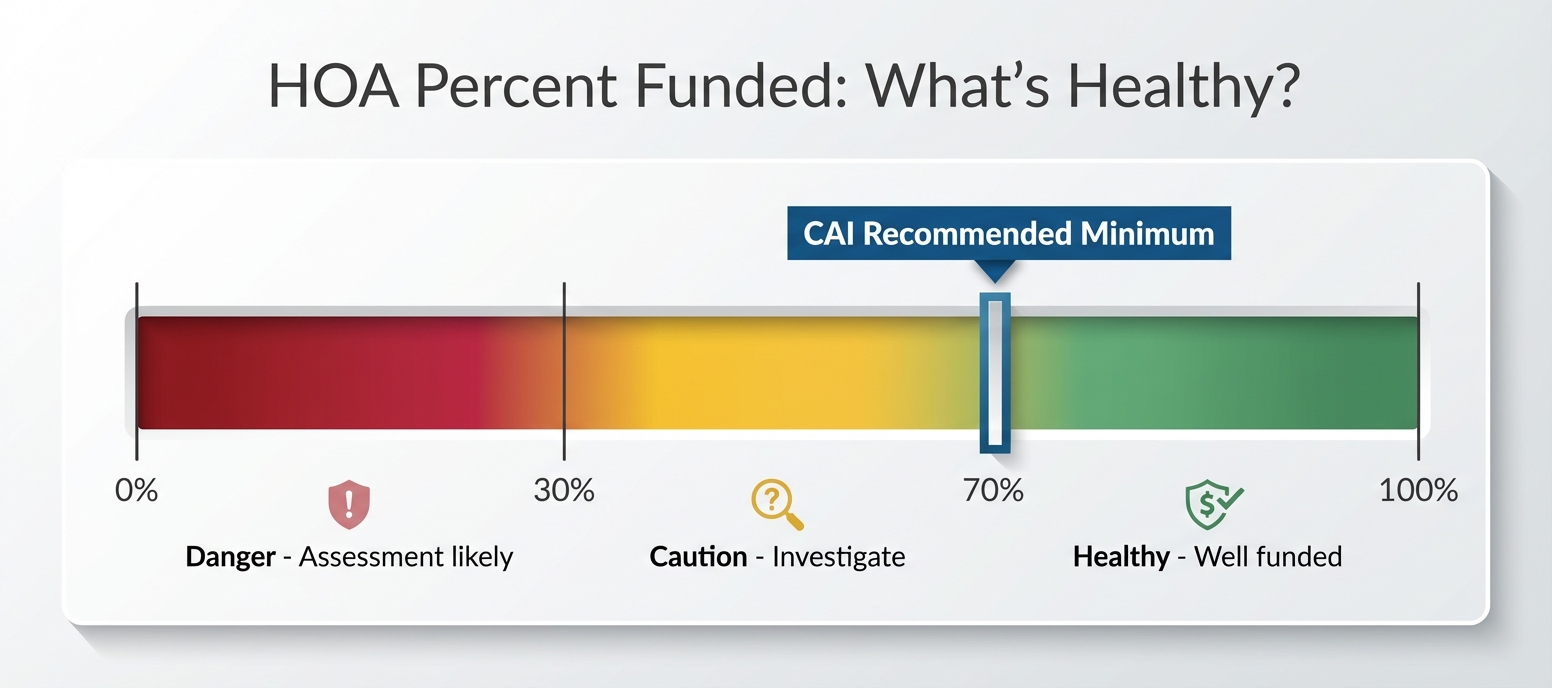
Where does your HOA fall on the funding scale?
Learn how to read a reserve study in 5 minutes →
Red Flag #2: Components Past End of Useful Life
When a reserve study shows components with Remaining Useful Life (RUL) of zero, those items should have already been replaced. Each RUL=0 component is a deferred cost waiting to become an emergency.
Every reserve study lists the building's major components and their Remaining Useful Life (RUL). Roof: 8 years. Elevator: 3 years. Pool resurfacing: 12 years. When that number hits zero, the component has reached the end of its expected lifespan.
A single RUL=0 item might be fine. The board may have inspected it and determined it still has life left. But when you see three or more components at RUL=0, it almost always signals a board that has been deferring replacements to avoid raising dues.
Common RUL=0 Items and Typical Per-Unit Costs
- • Roof replacement: $10K-$25K per unit
- • Elevator modernization: $5K-$15K per unit
- • Parking surface/garage: $3K-$8K per unit
- • Exterior paint/waterproofing: $2K-$6K per unit
- • Pool and spa equipment: $1K-$5K per unit
The worst cases in our corpus: buildings with 8-10 components past their useful life. Roofing, plumbing, electrical panels, elevator cabs, parking surfaces. All overdue. That's not maintenance being managed. That's a board kicking the can, and the next owner picks up the bill.
Where to find it: The reserve study's component inventory or detail pages. Look for the RUL column. Count how many items show 0, and add up their replacement costs.
Red Flag #3: Repeated Deferred Maintenance in Board Minutes
When the same maintenance item appears in board minutes across multiple months with no resolution, it signals a board that cannot or will not act. Deferred items become emergencies with emergency price tags.
Board minutes are where the real story lives. The financials tell you what the HOA has. The minutes tell you what the board does with it.
The pattern we see over and over: "Board discussed roof repair. Tabled until next meeting." Three months later: "Roof repair discussed again. Board to obtain additional bids." Six months later: "Emergency roof repair approved. Special assessment of $15,000 per unit."
That delay between "we should fix this" and "we have to fix this now" is where costs balloon. Preventive maintenance is always cheaper than emergency repair. A board that keeps tabling maintenance discussions is a board that will eventually send you a big bill.
Where to find it: Read 6-12 months of board meeting minutes. Search for words like "deferred," "tabled," "postponed," "delayed." Track which items keep reappearing without resolution.
Deep dive: 7 red flags in HOA meeting minutes →
Red Flag #4: Vague Special Assessment Language in CC&Rs
CC&Rs that give the board broad authority to levy special assessments without owner approval, spending caps, or clear procedures leave owners exposed to unlimited financial liability.
Most buyers never read the special assessment section of their CC&Rs. This is the clause that determines how much the board can charge you and whether they need your permission to do it.
In the best cases, CC&Rs require a membership vote for assessments above a certain dollar amount. They cap how much the board can levy without owner approval. They specify payment timelines and installment options.
In the worst cases, the language is something like: "The Board may levy special assessments as it deems necessary for the maintenance, repair, and replacement of common elements." No cap. No vote required. No limit on frequency. A Virginia court recently ruled that assessment language this vague may actually be unenforceable. But most owners don't have the resources to fight it in court.
Where to find it: Search the CC&Rs for "special assessment" or "additional assessment." Look for: dollar caps, vote requirements, payment terms, and frequency limits. If none exist, the board has broad authority.
Red Flag #5: Active or Threatened Litigation
Litigation drains reserve funds through legal fees, creates uncertainty about future costs, and can make buildings non-warrantable for conventional financing.
Lawsuits show up in two places: the disclosure package (if the state requires it) and the board meeting minutes. Sometimes they only show up in the minutes.
The direct cost is obvious. Legal fees come out of operating funds or reserves. But the indirect costs catch buyers off guard. Litigation related to a building's safety, structural soundness, or habitability can make a project non-warrantable under Fannie Mae guidelines, meaning conventional mortgages may not be available for units in that building. That limits your buyer pool when you sell and can push your interest rate higher. (Minor disputes like neighbor complaints or cases covered by insurance may not trigger this.)
Construction defect lawsuits are common in newer buildings. Owner-vs-board disputes are common in older ones. Both drain resources. In prolonged disputes, HOAs can spend $200,000+ in legal fees. That money comes out of reserves that were supposed to pay for the elevator replacement.
Where to find it: Check the disclosure statement for a litigation section. Read board minutes for mentions of "attorney," "counsel," "lawsuit," or "settlement." Also check the budget for a legal fees line item that seems high relative to the association's size.
Related: 5 legal risks in HOA properties →
When Red Flags Stack Up
One red flag is a concern. Two is a pattern. Three or more means you should seriously reconsider or negotiate hard on price.
These red flags rarely appear alone. An HOA with 20% reserve funding almost always has deferred maintenance in the minutes. A building with multiple RUL=0 components usually has vague assessment language because the board has been avoiding the hard conversations about money.
| Red Flags Found | Risk Level | Recommended Action |
|---|---|---|
| 0 | Low | Standard due diligence. Proceed with confidence. |
| 1 | Moderate | Investigate the specific issue. Ask the board for context. |
| 2 | Elevated | Get professional review. Negotiate price reduction. |
| 3+ | High | Strongly consider walking away or pricing in $20K-$50K+ in assessment risk. |
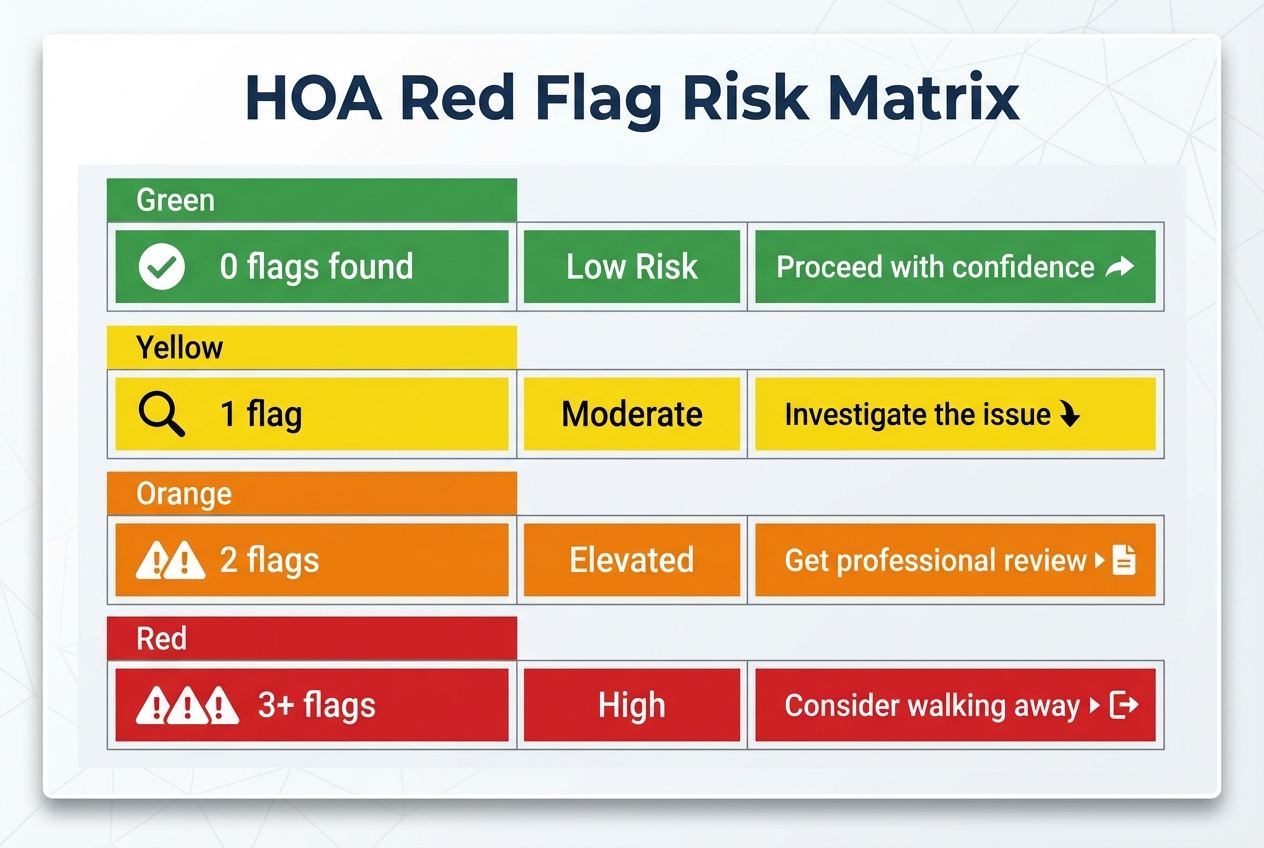
The good news: all five red flags are visible in the documents you receive during your review period. You just have to know where to look.
Quick Red Flag Checklist
- ☐Percent funded below 30% (reserve study)
- ☐3+ components with RUL=0 (reserve study)
- ☐Same maintenance item tabled 3+ months (board minutes)
- ☐No cap or vote requirement for assessments (CC&Rs)
- ☐Active lawsuits or high legal budget (disclosure/minutes)
What to Do When You Spot a Red Flag
Finding a red flag doesn't automatically mean walk away. It means ask questions, get context, and price the risk into your offer.
- Request the most recent reserve study. If it's more than 3 years old, that's a concern on its own. You want current numbers, not projections from 2021.
- Read 12 months of board minutes. Not the summary. The actual minutes. Track what issues keep coming up and whether they get resolved.
- Ask about planned assessments directly. Contact the management company or board and ask: "Are any special assessments currently planned or under discussion?" Get it in writing.
- Check the insurance certificate. Verify the building has adequate coverage. Gaps in coverage can lead to assessments after any major event.
- Negotiate based on what you find. If reserve funding is 25%, that gap has to be filled. Factor it into your offer price. A $15,000 expected assessment means your offer should be $15,000 lower.
Complete guide: How to review HOA documents before buying →
Check Your HOA Documents for Red Flags
Upload your CC&Rs or reserve study and get an instant analysis of risk factors, red flags, and what to ask the board before closing.
Frequently Asked Questions
What percent funded is considered a red flag for an HOA?
Below 30% is a serious red flag. Reserve study professionals rate 70% or above as "strong" funding. Between 30-70% is "fair" and deserves scrutiny. Below 30% is rated "weak," and a special assessment is likely just a matter of timing. Learn how to check reserve funding →
Can I find these red flags without hiring an attorney?
Yes. All five red flags are visible in standard HOA disclosure documents: the reserve study, CC&Rs, and board meeting minutes. The challenge is knowing where to look in 300+ pages under a tight review deadline. Tools like GoverningDocs can extract the relevant sections automatically.
How many red flags should make me walk away?
There's no universal number, but three or more red flags in the same building is a strong signal of systemic governance problems. At that point, you're not buying a unit with a fixable issue. You're buying into an HOA with a pattern of deferred responsibility.
Are these red flags different for condos vs single-family HOAs?
The red flags are the same, but the stakes are higher for condos. Condo associations manage shared structural components like roofs, elevators, and plumbing risers that can cost millions to replace. Single-family HOAs typically manage common areas like pools and landscaping, where the per-unit cost of failure is lower.
Should I ask for HOA documents before making an offer?
If the seller or their agent will provide them, absolutely. In some states, you can request the resale certificate or disclosure package before your offer is accepted. Getting documents early gives you more time to find red flags before the review clock starts ticking. Why the 3-day review period fails buyers →
Sources & References
- National Reserve Study Standards — Percent Funded — Association Reserves (100,000+ reserve studies, funding benchmarks)
- 2023 Homeowner Satisfaction Survey & Statistical Study — Foundation for Community Association Research (reserve funding statistics)
- Condominium Project Eligibility — Fannie Mae (warrantability guidelines for litigation and insurance)
Disclaimer: This article is for educational purposes only and does not constitute legal, financial, or real estate advice. HOA documents vary significantly by state and association. Consult a qualified attorney or real estate professional before making purchasing decisions based on HOA document review. GoverningDocs is a document analysis tool, not a substitute for professional advice.